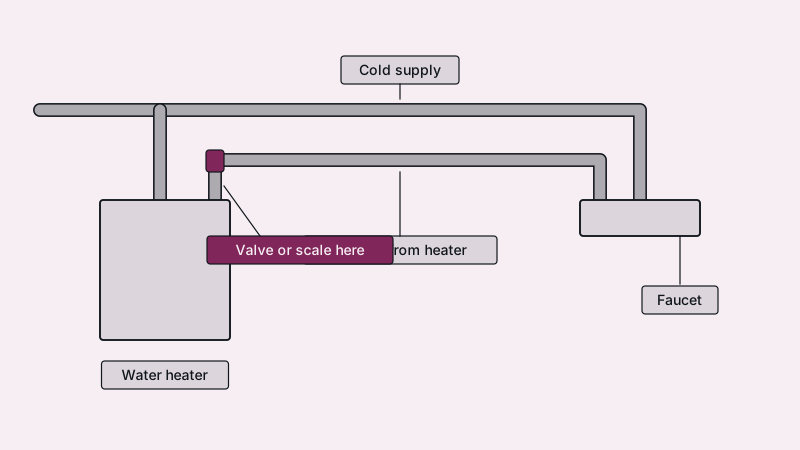
A strong cold tap beside a feeble hot one tells you the house supply is healthy. The trouble sits on the hot side, in the heater, its valves or the hot pipes. Usual suspects: mineral scale, a throttled valve, a blocked aerator or cartridge, and aging pipe closing up inside. Start with the water heater repair hub if the heater itself is acting up, or read on to sort the cause.
Is it only the hot water that is weak?
Try hot against cold in three spots: the kitchen, a bathroom basin and a shower. Poor flow on both sides everywhere implicates the supply or the regulator. Poor hot flow everywhere implicates the heater side. One sulking fixture implicates its own parts.
That one comparison saves most diagnostic time. Write the result down:
| Pattern | Where the fault likely is |
|---|---|
| Hot is poor everywhere and cold is strong | Heater outlet, a heater valve, the hot trunk line |
| Both temperatures poor everywhere | Main shutoff, regulator or street supply (see sudden low water pressure) |
| One fixture poor on hot | Its aerator, cartridge or supply hose |
| Strong at first, then fading | Scale inside the heater, a tiring mixing valve |
Could a valve beside the heater be strangling the flow?
Possibly, and looking costs nothing. Valves near the heater get knocked or were left cracked open after past work, so they restrict flow without closing it. On a lever valve the handle runs parallel to the pipe when open. On a wheel valve, spin it fully counter-clockwise.
Check the cold-water shutoff above the heater and the hot outlet valve if the previous plumber fitted one. Ease them to open. If one resists or drips as it moves, leave the replacement to a plumber. After any adjustment, let a hot tap run a minute to bleed out air.
Does scale on the hot side reduce pressure?
It does. Heating pushes dissolved minerals out of the water, which is why scale collects in the heater, its outlet and the hot-side fixtures. Hardness differs by district and street, and your water district's yearly quality report gives the number for yours, so expect scale over time wherever the water is hard.
Scale shows up in three places. A tank gets a crust on the bottom and sediment that rattles when it heats, and the outlet nipple and hot line can narrow. Faucet aerators clog with grit and grains, which is the easiest to test, because unscrewing the aerator and running the tap without it shows you the true pressure. Showerheads do the same and can be soaked in vinegar. A tankless unit is more sensitive still: scale on its heat exchanger lowers flow, and a plumber descales it. For fixtures and kettles, see removing hard water scale.
Are the pipes themselves narrowing?
Yes, in older homes. Galvanized steel pipe corrodes inside and narrows with rust, and the hot side tends to go first because heat speeds corrosion. Many planned-community houses of the 1960s to 1990s have copper or later PEX, so galvanized is rarer here, but it still turns up in older additions and mobile homes.
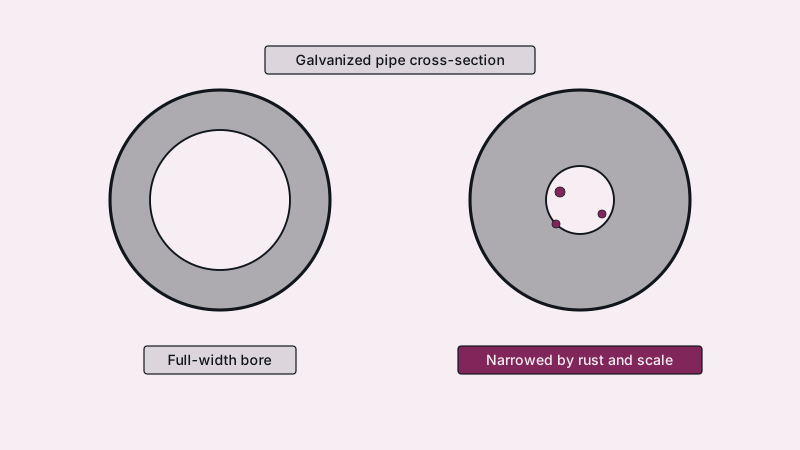
A tell-tale is brown water on first use, flow that was slowly getting worse for years, and weak pressure at the farthest fixtures. Pipes cannot be descaled with a bottle of cleaner. The fix is replacement of the narrowed run, covered on the galvanized pipe replacement page, or a repipe if the whole house is affected. A plumber can confirm by pressure testing and a camera look at accessible sections.
Is the tank worn out or just dirty?
A tank full of sediment does not stop pressure on its own, but sediment can clog the outlet or the dip tube, and a failing tank can shed flakes that block aerators. If flow drops after hot water has been running for a few minutes, or the heater makes rumbling sounds, flush it, as the maker's manual describes.
Draw off several gallons at the tank's spigot into a pail or hose, and watch the stream for grit, flakes or rust color. Switch off power or gas first, as the label says. Respect the heat: Wikipedia notes skin can burn in less than five seconds at 140 degrees Fahrenheit. Rusty discharge suggests the tank is close to retirement, and the water heater replacement page lays out the choices.
A gas smell overrides all of this. Leave and report it outside, to SoCalGas.
What will the visit involve?
The plumber gauges pressure at an outdoor spigot, checks the heater valves, flushes the tank, cleans aerators and cartridges, and tests the lines. Narrowed pipe leads to a repair or repipe quote. The written quote should list what was found and what each fix costs.
Ask for the pressure as a figure. A reading at an outside spigot separates a regulator fault from a hot-side one. If the weakness comes and goes, note when. Book through the quote form, or browse the home page. The anode rod article explains the tank maintenance that slows scale and corrosion.
Common questions
What explains hot flow that lags behind cold?
Cold water comes straight off the supply. Hot water takes a detour through the heater and its valves, and scale, a half-shut valve or corroded pipe can choke it there. Try several fixtures, and if the pattern repeats, the plumber begins at the heater.
Does a tankless unit lower hot flow?
It can. A flow sensor and narrow heat exchanger sit inside, and scale or a clogged inlet screen restricts both. A minimum flow rate is also required before most models ignite. Look at the inlet screen, read the error code and book a descaling. Our gas tankless repair page covers it.
Would a new pressure regulator help if only hot is weak?
Probably not. A regulator governs the whole house, so a regulator fault shows up on hot and cold together. For a hot-only problem, look at the heater, its valves and the hot line. If both sides are weak or too strong, the pressure regulator article shows where to find it.
Is weak hot water a sign of a leak?
It can be. A leak on the hot line sends flow out of the pipe before it reaches the tap, and may leave a warm wet spot on a floor or wall. Check for damp, hot patches and a hot-water meter test. If you suspect one, see the leak plumber page.
Sources
Updated