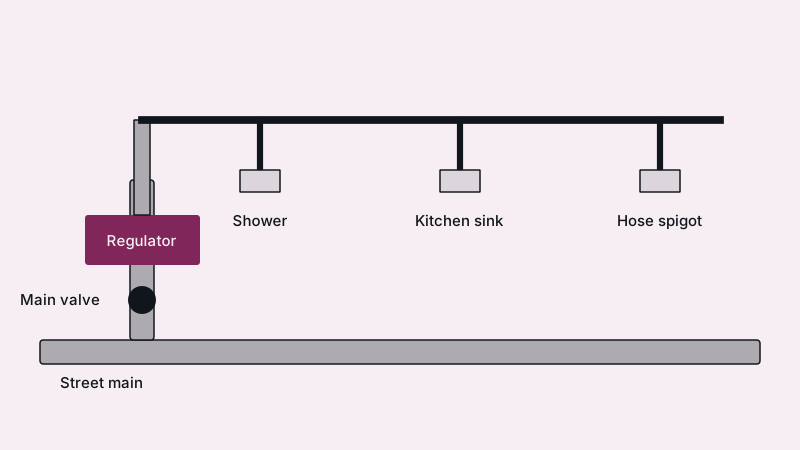
A trickle at one tap and a trickle everywhere are two different problems, and a plumber begins by telling them apart. Trouble at a single fixture usually traces to a gummed aerator, a tired cartridge or a kinked flex line. Trouble everywhere traces to the regulator, the main valve, a leak or furred-up pipe. A local plumber is sent to test and repair whichever it proves to be; book through the quote request, or browse the rest of the work from the Capistrano Plumbing home page.
Where in the house is the pressure weak, and why does that decide the fix?
Scope is the first clue. A single faucet or shower blames that fixture. Weakness on hot alone blames the heater and its valves. Weakness at every tap blames the supply side: main valve, regulator, a leak upstream, or pipe that has narrowed.
Run a two-minute survey before you phone. Try the tub, a hose spigot and the kitchen sink in turn, and write down which ones disappoint. That note saves billable time later. For a single-fixture complaint, the pages on shower pressure and kitchen faucet pressure cover the home checks.
How does a plumber measure water pressure?
With a gauge that threads onto a hose spigot, with every other tap and appliance off. Many homes run between 40 and 60 psi, California plumbing code (CPC 608.2) calls for a regulator above 80, and a reading well under 40 tends to feel weak at the shower. The needle also shows whether pressure collapses when a tap opens, which indicates restricted pipe.
A second reading, taken with a tap open, catches the difference between static and flowing pressure. A house can read fine at rest and starve under flow when pipe has narrowed from mineral buildup inside. Hard imported water, common across south Orange County, leaves that kind of scale in older galvanized and copper runs. The article on what makes pressure low at home walks the same logic in a homeowner's order.
What is a pressure regulator, and why might it be the culprit?
Picture a squat, bell-bodied valve beside the main: it cuts the street's pressure down to something the house can live with. When its diaphragm tires or the spring drifts, pressure falls and stays low, or swings between extremes. Pressure can run high on lots lower down a slope, which is one reason regulators are common in hillside tracts.
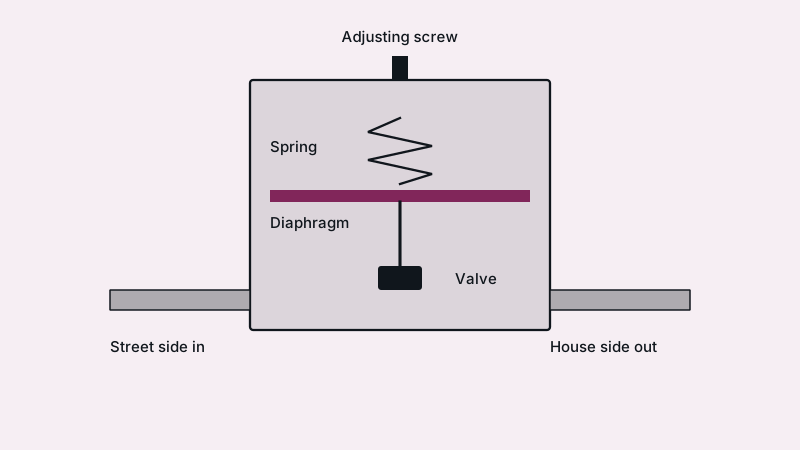
A failing one may also let pressure creep upward overnight, so a gauge that rises on a quiet house is itself a warning. If you want to find yours, where the regulator is located shows the usual spots, and adjusting the valve explains the screw. Replacement is covered in water pressure regulator replacement.
Plumber or water district: whose problem is a pressure drop?
Call a plumber when the drop is inside your property line. Call the water district when neighbors have the same trouble, when the street is under repair, or when you see water in the street. Most of Mission Viejo takes its water from Moulton Niguel Water District, though your bill names the supplier for your address.
A fast neighbor check settles it. If next door runs fine, the problem is yours. If both houses weaken at the same hour, the district's operations line is the right call. Water that suddenly changes pressure after a day of street work also belongs with the district, since airlocks and disturbed sediment clear on their own.
What does a pressure repair cost?
Cleaning an aerator or fitting a new cartridge is the cheap end, and a plumber prices it on the visit. Fixr lists replacing a water pressure regulator, labor included, at $250 to $1,000. Swapping out a stretch of corroded pipe costs more and is priced after someone looks. Read these as a rough guide; the number that binds arrives on your written quote.
Fixr puts most plumbers at $75 to $150 an hour nationally, with a service call fee of $50 to $300 on top. What moves the total: valve size, access to the valve, and whether the main shutoff also needs replacing. Line-by-line figures are in regulator installation cost.
Is swapping a regulator a weekend job for a homeowner?
Many handy owners can, since it is a threaded or sweated swap at the main with the water closed, and then reset to a reasonable psi. The catch is the solder joints and the shutoff that may not close fully. If either one is doubtful, a plumber does it faster than a weekend of drips.
A main valve that refuses to close fully ends the job early: stop and call. Set the final number by gauge, well under the 80 psi code ceiling, then run a meter test for two hours to confirm nothing weeps.
What should my pressure tank be set to?
Only homes with a private well and a pressure tank have this question. City-supplied houses, which is nearly all of Mission Viejo, have no tank at all. For well owners, the tank's air charge typically sits roughly 2 psi under the pump's cut-in point, measured with the tank drained, so a 40/60 switch calls for 38 psi.
Check the manual before changing anything. A waterlogged tank cycles the pump constantly and sounds like chattering. That case is better handled by a pump or well specialist than by a general plumber.
Does weak pressure do harm, and what about irrigation zones?
Low pressure harms nothing in the pipes by itself. It signals something else, and sometimes that something is a hidden leak, the one to chase. EPA puts an average household's leak losses above 9,300 gallons every twelve months. Weak flow can also keep some tankless heaters from lighting.
Sprinkler zones struggle first, since many heads share one line, so a plumber may suggest splitting the zones rather than raising pressure. Showers show it earliest; WaterSense heads are tested to keep flow steady across pressures. Drinking water has no link to blood pressure in the body, which is a question for a doctor.
Common questions
How do I spot a dodgy plumber on a pressure job?
Doubt anyone who quotes before testing, calls for new pipe without a gauge reading, or asks for a large deposit. A contractor may take at most 10 percent of the price or $1,000 as a deposit, whichever is less, and a contractor license is required on jobs of $1,000 or more. Ask to see the number.
Do plumbers repair broken water pipes too?
Yes. Plumbers cut out and replace split, corroded or leaking pipe, and a pressure complaint often turns out to be exactly that. A meter that keeps moving with everything off is the giveaway. For visible damage and active leaks, our leak repair service covers the urgent side of the same work.
Why does pressure drop suddenly in cold weather?
Cold itself rarely does it here. Rising demand, a half-closed valve after other work, or a leak that has just worsened are likelier. Compare a quick gauge reading with last month's. If it fell fast, read sudden low water pressure before booking.
How do I find a low-cost plumber for this?
Collect two or three quotes covering identical work and compare the totals, since a low hourly rate with a slow visit can cost more than a flat price. Pass on any quote that will not list what it includes, and compare scope before price.
More in this guide
- Adjust a pressure regulator
Adjust, test or replace a home water pressure regulator: the gauge test, the adjusting screw, when to stop, and what a Mission Viejo…
- Sudden low pressure
Water pressure dropped overnight? Check neighbors and the district first, then the main valve, a hidden leak and the regulator.
- Low water pressure
What drives the cost to install or replace a water pressure regulator in a Mission Viejo home: access, pipe size, expansion tank, permit,…
- Pressure regulator replacement
When a failing pressure regulator needs replacing in a Mission Viejo home: how to read your pressure, what a swap involves and why an…
- Finding the pressure regulator
Where to find the water pressure regulator in a Mission Viejo home: near the main shutoff, in the garage, by the front hose bib or at the…
- Why is my water pressure low
Weak pressure at one tap, the hot side or the whole house has different causes.
Sources
Updated