Look on the pipe where water enters the house, close to the main shutoff valve. Common spots are a garage wall, a utility closet, the corner by the water heater, or a cover in the yard by the front spigot. Expect a brass dome, about as big as your fist, topped by an adjustment bolt. Weak or uneven flow is its own subject on the low water pressure page; here the job is finding the regulator and judging what it is doing.
How do I recognize one?
Think brass or bronze, domed like a bell, with pipe entering one side and leaving the other. On top sits a threaded bolt with a locknut, and some models have a gauge port. A handle or wheel means you are looking at a shutoff valve, so the bell silhouette is the giveaway.
Some carry a small strainer plug where the water comes in. Elderly units may be crusty or painted over. A label may carry the brand and a factory pressure setting. If you see a round dial, that is a gauge, not the regulator. Many houses have no visible regulator because it is buried in a box or located at the street side, and some older homes have none.
Which part of the house should I search first?
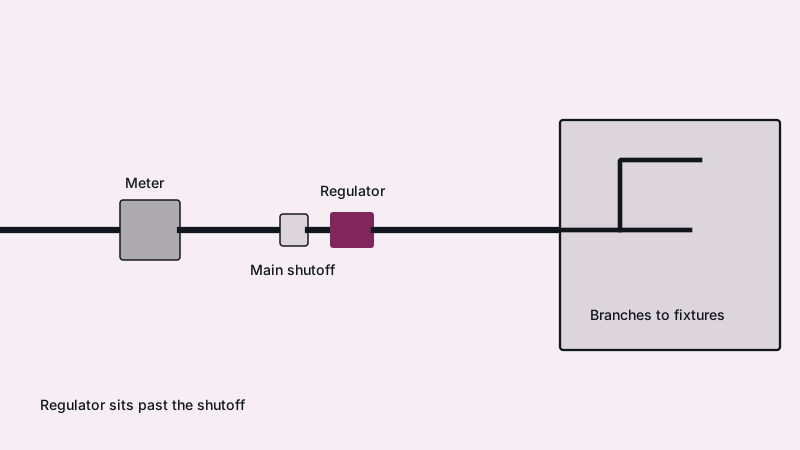
Work through these in order: the garage wall where the line comes in, next to the main shutoff; a closet holding the water heater; any utility room; the ground box by the front spigot; the crawlspace entry point; and the meter box. The regulator sits after the main shutoff and ahead of the branches.
How it differs by house:
- Garage or slab homes: often on the line behind the garage wall or near the water heater, where the supply rises out of the slab.
- Front-yard entry: a short run of pipe leaves the meter for the house wall, with the regulator in a buried box or just inside.
- Crawlspace homes: beneath the floor, close to where the supply arrives.
- Homes with no regulator: street pressure goes straight to the house, so pressure depends on where you live.
Trace the pipe from the main shutoff. The bell-shaped fitting just past it is your regulator. Water district property ends at the meter, and Moulton Niguel Water District says everything past the meter is the owner's, so a regulator downstream of the meter is yours to maintain.
How do I know whether it is working?
Screw a gauge to an outside faucet, shut all the indoor taps and write down the static reading. The state plumbing code expects a regulator whenever static pressure goes beyond 80 psi, and holds it at 80 or below. Many homes run well under that. A reading over 80 means the regulator has failed or was never fitted.
Signs of a tired regulator include pressure that climbs overnight, knocking pipes, a relief valve that weeps, faucets that leak, and fixtures that wear out too soon. Low pressure can also mean a failing regulator that has choked down, or a partly closed valve. Hammering is covered in water hammer sounds, and a sudden drop is in sudden low pressure.
Is turning the adjustment bolt a safe do-it-yourself job?
Often, on a model with a bolt: slacken the locknut, give the bolt a quarter turn, check the gauge, then lock it down. On most models clockwise adds pressure and counterclockwise removes it. Move slowly and recheck after a day, since settings can drift. If it will not hold, replace it.
Step-by-step instructions live in adjusting a regulator valve. Do not exceed the 80 psi limit in the code. A leaking or seized unit, or a gauge that ignores the bolt, is plumber territory, and the swap itself (main off, old unit out, new one in) is covered under regulator replacement.
Does a regulator affect the water heater?
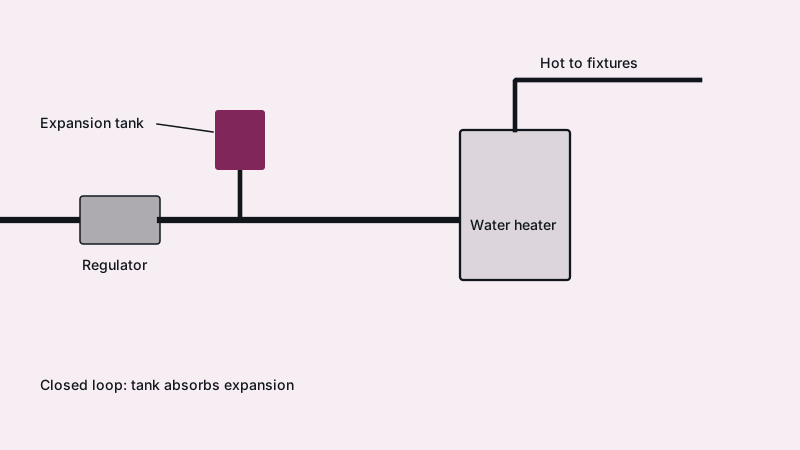
Yes. A regulator makes the house a closed system, so heated water has nowhere to expand and pressure spikes. An expansion tank is often needed on the cold line once a regulator closes the system, and IAPMO's commentary says a regulator creates the closed condition, so ask your plumber or Building Services whether your heater needs one. A weeping relief valve is the classic clue.
If your regulator was fitted without an expansion tank, the heater may suffer. See expansion tank replacement. What a new regulator costs is on the installation cost page. For a quote, go to the price request page; weekday requests are read between 9 and 5. If the worry is weak flow rather than strong, read causes of low water pressure. The Capistrano Plumbing home page explains the process.
Common questions
Searched everywhere and still no regulator?
Some houses have none, some bury it in a box, and some keep it at the meter. Trace the supply from the main shutoff through the garage, heater area and crawlspace. Still nothing? A plumber can usually find it, or confirm that none exists, with a gauge reading and a short look around.
Can I mistake the regulator for the main shutoff?
Easily. The shutoff has a handle or wheel and simply stops flow. The regulator is the bell-shaped fitting beside it that governs pressure. Know where both are before an emergency, and label the main shutoff so family members can close it.
What pressure should my house have?
The code limit is 80 psi at most. Many homes are comfortable well below it, and the right setting depends on fixtures and preference. Trust a gauge on an outside faucet, not your hand. If the reading is above 80, a regulator should be installed or repaired.
How long does a regulator last?
There is no single figure. Mineral buildup, wear and pressure swings shorten life, and hard water does not help; Moulton Niguel's recent report lists hardness near 9 to 18 grains per gallon by source, and your district may differ. Check pressure once a year and replace the regulator when it creeps, leaks or stops holding the setting.
Whose job is it to maintain the regulator?
Usually the owner's. The district keeps the meter and the line up to it, while the plumbing past the meter is the customer's under Moulton Niguel Water District's Fix-a-Leak page. If Santa Margarita or El Toro serves you, ask them, and have a plumber read the setting.
Sources
Updated