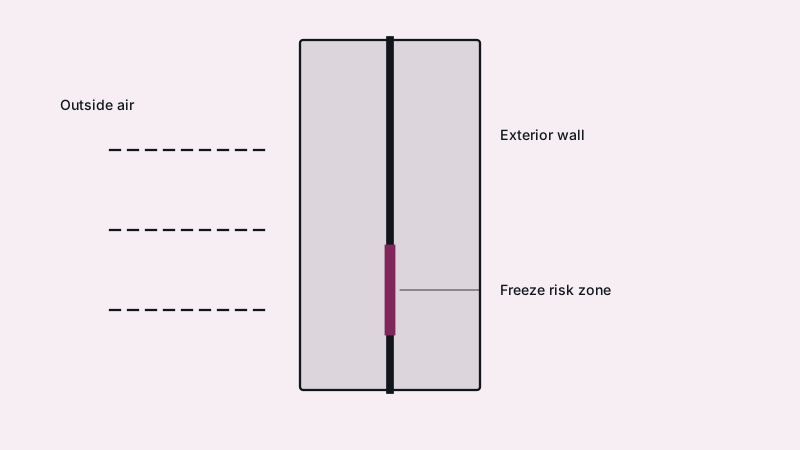
Cold is the textbook reason for a split pipe, and it is low on the list in Mission Viejo. Here the ranking runs pressure first, then age, then neglected hoses, with a rare frost night somewhere behind. The cheap defenses are a working main shutoff, a pressure reading, new hoses on a calendar, and one meter test each season. Those steps sit at the front end of our leak repair work. A pipe already spraying? Jump to the shutoff section. If you want a plumber at the house, send the quote form.
Which pipes give way first in a house here?
Three spots top the list: the thin braided lines beneath sinks and beside toilets, the braided hoses feeding the washer and dishwasher, and old pipe inside the walls. Wall pipe three or four decades old can corrode through from within or crack at a fitting, then run for hours before anyone hears it.
Mission Viejo went from roughly 12,000 residents in 1970 to roughly 73,000 in 1990, so original plumbing from that stretch is common. Polybutylene, a gray plastic that tends to fail at its fittings, went into several million North American homes from about 1978 to 1997. Polybutylene replacement explains how to recognize it.
Can too much water pressure split a pipe?
It can, quietly, over years. Pressure that stays high fatigues fittings, hoses and valves, and each slammed valve adds a shock wave on top of it. Wikipedia lists the outcomes of a pressure surge as anything between noise and a ruptured pipe. A regulator at the main is the standard cure and costs little next to a flooded kitchen.
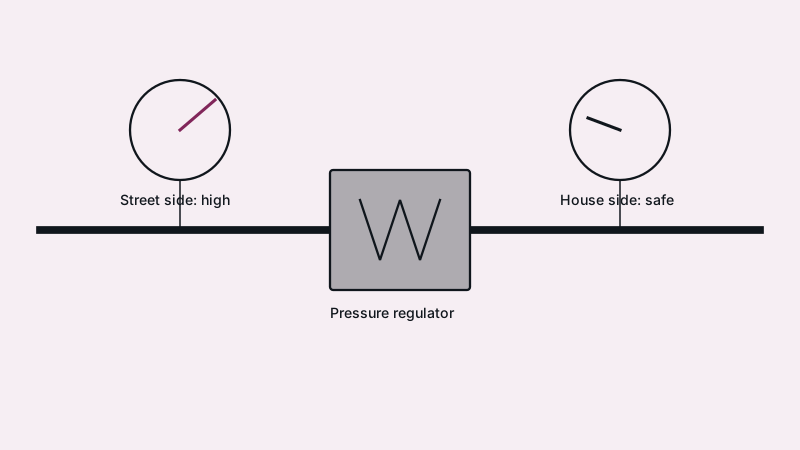
On sloping ground, lots lower down the hill can see more pressure than lots up near the tank, because the district feeds the area from above. A gauge on a hose spigot, with everything inside shut, gives the number. If it reads high, our walkthrough on adjusting a regulator applies, and knocking pipes are explained under water hammer sound.
Is freezing a real risk in Mission Viejo?
Seldom, though not never. Hard freezes lasting several hours are unusual here, and most piping hides in walls or under slabs. What sits exposed: outdoor spigots, above-ground irrigation, and lines in garage walls or attics during an odd cold snap.
Small precautions cover those nights. Unhook hoses, snap foam covers on spigots, and prop open the cabinet under a sink on an outside wall. Pipe that has already frozen is a plumber's job unless you can reach it safely.
How can a hidden leak be caught early?
Use the meter as a witness. EPA suggests noting the reading, leaving every tap and appliance untouched for two hours, then reading it once more. A dial that moved points to a leak. EPA also says a four-person household that burns through 12,000 gallons or more in a chilly month is probably leaking.
Three low-effort extras:
- Run a palm along the floor of every sink cabinet, feeling for damp.
- Add dye to each toilet tank, wait, and check whether it shows in the bowl.
- Scan ceilings and wall bases for stains, bubbled paint or a musty smell.
When the meter moves and you cannot find the cause, leak detection locates it without opening every wall.
Which parts should go on a replacement schedule?
The cheap, failure-prone ones: washer and dishwasher hoses, toilet and sink supply lines, and the water heater's connectors and relief valve. Hose failure is among the more common household floods, and the part costs very little next to the damage.
Check for bulges, rust at the crimped ends, and any dampness. Write the install date on each hose in marker so the next owner knows its age. Exercise the main shutoff as well, since old ones seize, and a valve that will not budge is exactly how a small burst grows.
Can I find and work my main valve in the dark?
Follow the pipe from where water enters the property. Garages, the spot beside the water heater, the front stucco wall and a ground box by the curb are the usual homes. A lever shuts with a quarter turn, while a round wheel needs several clockwise turns. Work it yearly so it still moves when it counts.
During a burst, the sequence is: main closed, water heater off, lowest faucet open to drain the lines. Cut power to a wet area only from dry footing, and keep out of standing water near outlets.
For symptoms, read signs that a pipe has burst. Triggers are broken down under what makes pipes burst.
How do I prepare the plumbing for a long absence?
On the way out, shut the main and open one tap to bleed the pressure. Put the water heater on vacation or off. A house with nobody home can leak into its walls for weeks, and that delay is what turns a small failure into major damage.
A neighbor with a key and a battery leak sensor under the water heater and each sink add cheap coverage. Irrigation on a timer may be fed from a separate branch, so ask the plumber whether it depends on the house main.
If a pipe bursts anyway, does insurance pay?
Frequently for a sudden break, less often for slow seepage, and the wording of the policy decides. Typical terms and the photos worth taking are in the burst pipe insurance guide. Maintenance counts here: insurers can treat long-term leaking differently from a sudden failure.
Common questions
How do I keep a pipe in my wall from bursting?
Control what you can. Keep pressure at or under 80 psi, the California Plumbing Code 608.2 limit, with a regulator, retire polybutylene and badly corroded galvanized pipe, and stop water hammer. Walls hide the rest, so run the meter test every season. Watch for a ceiling stain or a bill that drifts upward while habits stay the same.
What is the very first move during a burst?
The main valve, then the water heater, then the lowest tap. Carry valuables to dry ground and take photos before cleanup for the insurer. Do not wade near outlets or the electrical panel. After that, phone a plumber, or arrange one through emergency plumbing.
Can a slab leak end in a burst?
It can. A line under the concrete may weep for months, then split, and the water finds a path upward through the floor. Warm patches on tile, running-water sounds with every fixture off, and a rising bill are the signs. Electronic detection pinpoints it without breaking the whole slab.
Should pipes be replaced before they fail?
When a pipe type is known to fail, such as polybutylene, yes, since the flood costs more than the repipe. For copper with a few pinholes, a plumber can read the pattern and say whether more are coming. Repiping is a quoted job, so ask for the price on paper and ask about permits.
The rest of our guides start from the plumber guide for Mission Viejo.
Sources
Updated