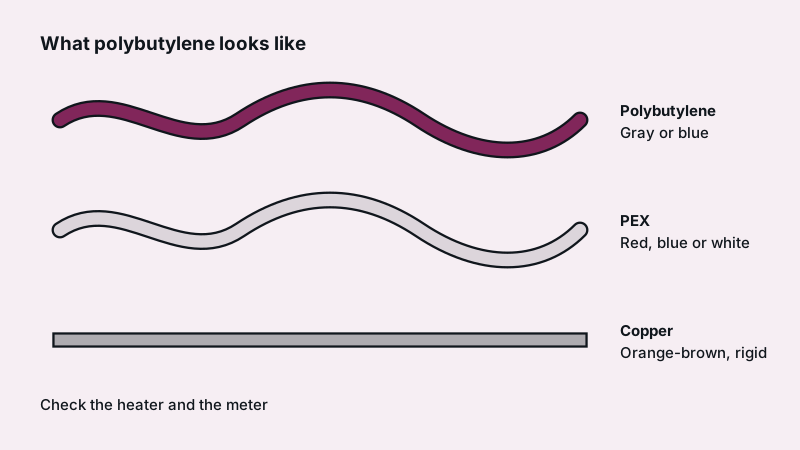
Walk to your water heater. If the line coming in, or the one leaving the tank, is bendy plastic in gray or blue, you may have polybutylene. It was sold as Poly-B in the late 1970s through the 1990s, which overlaps with much of Mission Viejo's housing growth. The material is the worry: disinfectant in tap water slowly eats it away internally, so a leak can appear with no warning. The standard fix is a whole-house repipe, usually in PEX.
What does polybutylene look like in a house?
It is bendy plastic in gray, blue or sometimes black, found at the water heater, the main shutoff, under sinks and at the meter. Many runs are printed with a code such as PB2110, and plastic fittings with metal crimp rings are another giveaway. Homes built between roughly 1978 and 1997 deserve the first look.
Places to look:
- At the heater closet, where both lines sit in plain sight.
- At the main shutoff and regulator.
- Beneath kitchen and bathroom sinks, on the supply lines.
- Along any exposed runs overhead or below the floor.
PEX can look similar, but it comes in red, blue or white and carries different printing. Copper is orange-brown. Stumped? Photograph the pipe and attach it to a price request so a plumber can identify it.
Why does polybutylene fail?
Treated water attacks it from within. Published accounts say the chlorine and chloramine that disinfect public supplies degrade the pipe and its acetal plastic fittings, and strain at bends and joints speeds the process. The result can be flaking, weeping joints or a sudden burst, and the damage is invisible from outside.
Failure timing is unpredictable. Some systems leak within a few years. Others hold on for decades. That is why there is no safe date. A pipe that has not leaked yet is not proof it is fine, and a leak in one spot says little about whether the rest will follow.
Pressure plays a part. High street pressure on hillsides, or a regulator that has quit, makes weak pipe work harder. The check is in adjusting a pressure regulator.
Do I have to replace it, or can I wait?
No law forces you to replace it, but waiting is a gamble with your walls and floors. A burst can soak a house in minutes, and insurers, lenders and buyers all react to it. If your pipe is polybutylene, plan the replacement on your schedule, not during a flood.
Reasons people do not wait:
- A single leak usually means more are coming.
- Some insurers ask about polybutylene, and some add conditions or decline coverage. Ask yours.
- Sellers in California complete a disclosure form and must report known defects, so Poly-B can affect a sale.
- Water damage from a burst costs far more than a planned repipe.
A class action over polybutylene (Cox v. Shell Oil) produced a large settlement years ago, but do not assume any money is available to you now. Check with an attorney if you think you have a claim.
How much does a polybutylene repipe cost?
One published contractor guide shows a PEX repipe near $3,500 to $6,000 for a small single-bath house, climbing to $8,000 to $14,000 around 2,200 square feet, and copper costs about twice that. Permits, patching and size shift the total, and only a written quote sets your price.
Line-by-line figures are in the repipe house cost guide, while PEX repipe pricing narrows in on PEX. Have each bid split out the permit, wall repair and pressure test. The numbers above come from that one published guide and are not an offer.
Is a partial replacement ever enough?
Sometimes, but it is a trade. Replacing the worst branch can cost less and fix an active leak. The rest of the polybutylene remains and can fail later. Mixing materials requires the right transition fittings, and many plumbers recommend a full repipe if most of the house is Poly-B.
Have the plumber explain what stays, what goes, and whether the remaining runs can be reached if they fail. A house going on the market soon may be easier to sell with a full replacement than a partial one.
Which replacement material should I choose?
PEX is the usual choice: flexible, resistant to scale and fast to install. Copper is rigid and has a long record, at a higher price. Each has fans. See PEX vs copper for the comparison. Whichever you pick, the bid should state the pipe, its rating and the fitting style.

Local water is hard, and copper can pinhole in some conditions, a failure PEX does not share. That is one reason many Poly-B owners pick PEX. Ask the plumber why they recommend what they do, rather than accepting one answer.
What happens during the work, and who may do it?
The water goes off, small access holes open in the walls, new lines run through attics, garages or crawl spaces wherever possible, fixtures reconnect, the system gets a pressure test, and patching follows. Mission Viejo's Building Division issues the permit and sends the inspector.
From $1,000 in labor and materials upward, the job needs a contractor with a California license. Check it on the state board's website, insist on a written bid, and hold any deposit to the legal limit. For the general process, read how to repipe a house, and for motives, why people repipe.
Common questions
Is Poly-B just an older kind of PEX?
No. Both are flexible plastic pipes, but polybutylene is a different material that was widely used in homes from the late 1970s and degrades with chlorinated water. PEX is cross-linked polyethylene, used today. They can look alike at a glance, so check the printing.
Will my homeowners insurance cover a polybutylene leak?
The resulting water damage may be covered if it was sudden, though the failed pipe is normally your expense, and some insurers add conditions for homes with Poly-B. Ask your insurer directly, in writing, what it requires. Our page on broken pipe insurance explains the usual split.
Can I sell a house with polybutylene?
Yes, but you must disclose it if you know. Buyers often ask for a price credit or a repipe ahead of closing, so replacing it before you list can take the issue off the table. Ask your agent how local buyers treat it, and keep the permit records.
How long will the work disrupt the house?
Usually a few days of plumbing, with the supply cut off for a stretch each day, then wall patching. Bigger or two-story homes run longer. Ask for the shutoff periods in writing, and arrange somewhere to stay if you rely on running water for medical reasons.
Is there a cheaper option than replacing everything?
Replacing only the failing section costs less, but the remaining pipe stays at risk. If money is tight, ask for a phased plan: fix the worst branches first and schedule the rest. Avoid products that promise to coat or seal old Poly-B unless a plumber can explain their record.
For the wider picture, start with plumber across Mission Viejo.
Sources
Updated