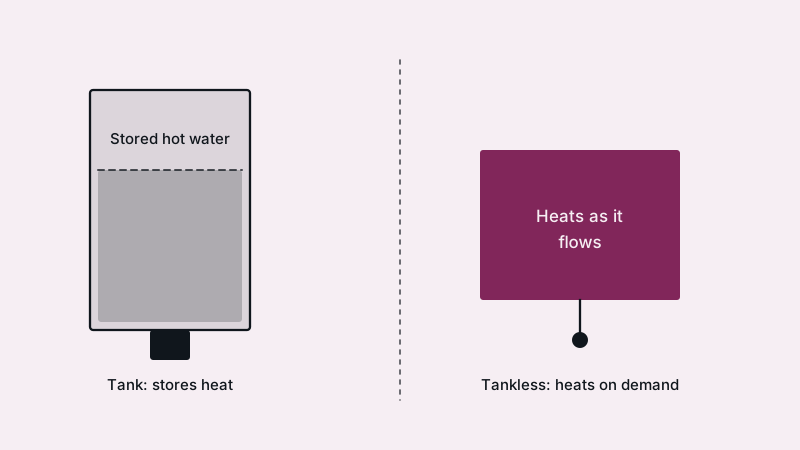
Picture a Saturday morning with four people showering. A 40-gallon tank runs warm, then lukewarm, then cold. A tankless heater would hold its temperature the whole time, as long as no more than its rated flow is asking for water. That is the real contrast. A tank stores heat and spends it down. A tankless unit makes heat on demand. The water heater repair hub covers breakdowns for both, and this page helps you decide which to buy.
Which one suits a busy household, a tank or a tankless unit?
Tankless fits a busy household that keeps hitting cold water, provided the gas line can feed it. A tank fits a smaller household, a tight budget or a house where changing gas pipe and vent is a headache. Habits, fuel and the pipe layout decide it more than any brand does.
A side-by-side view, using HomeGuide's published ranges rather than a quote:
| Tank | Tankless | |
|---|---|---|
| Installed, HomeGuide range | $600 to $3,100 | $2,100 to $5,600 (gas) |
| Runs out? | Yes, after the tank empties | No, but flow has a ceiling |
| Heat kept ready all day | Yes, which wastes some | No |
| Often quoted life | 10 to 15 years | 20 or more |
| Floor space | A closet or garage corner | A wall bracket |
| Extra work at install | Little | Gas pipe, vent, power |
Why does a gas tankless install cost so much more than a tank?
The unit is only part of it. HomeGuide puts a gas tankless install at $2,100 to $5,600 and a standard tank swap at $600 to $3,100. Most of the difference is the pipe work around the heater: a wider gas line, a new vent route, power and the permit.
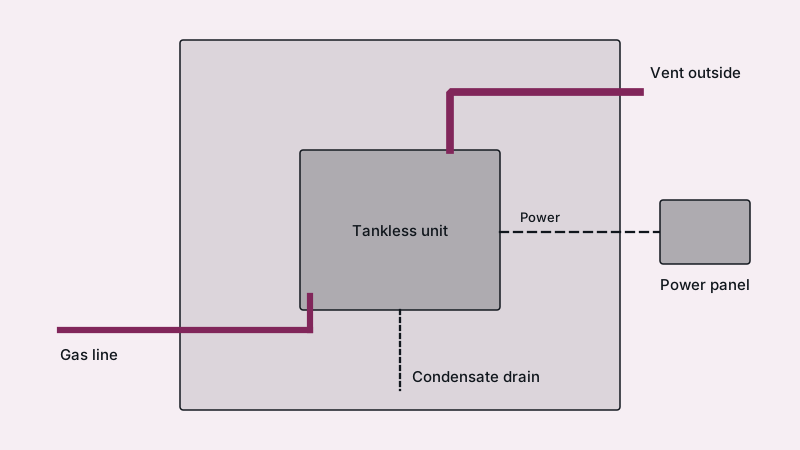
Walk through what changes on a tankless job:
- Gas. The burner wants a lot of fuel at once. A line sized for a tank may starve it, and a bigger line costs more the longer the run.
- Vent. High-efficiency models push exhaust through plastic pipe and drain acidic condensate. Others need stainless vent. Both routes can mean opening a wall.
- Power. A gas unit still plugs in. An electric tankless unit needs heavy circuits that an older panel may lack.
- Permit. California requires one for a heater replacement, and how the heater permit works here is spelled out separately.
The tankless installation cost guide goes line by line.
How long before a tankless heater pays for itself?
Often longer than you want. The U.S. Department of Energy says a tankless unit can be 24 to 34 percent more efficient in a light-use home and 8 to 14 percent in a heavy-use one. Payback can stretch past the life of a tank.
Do your own sum:
- Subtract the tank's installed price from the tankless price.
- Estimate what water heating costs you in gas each year. Comparing winter and summer SoCalGas bills hints at it.
- Apply the low-use saving unless your showers are many and long.
- Divide the extra price by the yearly saving.
If that number is bigger than the years a tank would last, buy tankless for comfort, not savings. Be wary of old articles, too. Federal rules for tank heaters tightened in 2015, so a 2016 comparison may measure against models that no longer ship.
What do gas, electric and propane change about the choice?
Fuel narrows the field before price does. Natural gas is common in Mission Viejo, so gas tank and gas tankless are the usual pair. Electric tankless draws so much current that it rarely works as a whole-house unit on an older panel. Propane makes sense where no gas main exists.
- Gas tank. The cheapest to buy. Expect a vent, a gas shutoff, a drain pipe for the relief valve and earthquake straps.
- Gas tankless. The highest output from a wall-hung box. Fixtures that run at once set the size you need.
- Electric tank. No vent, easy placement, higher running cost. See the electric replacement cost guide.
- Electric tankless. A better match for one sink or a small unit than a house.
- Propane. Possible with a tank on site. The supplier sets placement rules.
Gas piping counts as regulated plumbing. Above $1,000 for labor plus materials, California wants the work done under a contractor license, so search the name in the state board's lookup before you sign.
What about a mini tank for one far-off tap?
A mini tank is a 2.5 to 6 gallon heater that plugs in under a sink. It cures a long wait at one faucet and does nothing for a whole house. Think guest bath, laundry sink or garage workshop. Run a shower from it and the water turns cold within minutes.
For the whole house, your real choices are a full tank, a tankless unit, or a heat pump model, an electric design with its own rules.
Which type is easier and cheaper to fix when it fails?
A tank is easier and cheaper to fix in most cases. Its common problems are a bad thermostat, element, relief valve or igniter. If the shell itself rusts through, the answer is a new heater. A tankless unit moves the risk to scale, vent blockage and fault codes, and its parts cost more.
Local detail matters here. Much of South Orange County has moderately to very hard water, and your water district's yearly quality report gives the number for your street. In a tankless unit that scale builds inside the heat exchanger, so plan on a vinegar or descaling flush about once a year. A tank gets sediment, and a rod inside it, covered in the anode rod guide, is its defense. The tankless repair cost page lists faults and typical prices.
Smell gas near either one? Walk out, ring SoCalGas at 1-800-427-2200 once you are outside, and dial 911 if you feel unsafe.
Common questions
Would a tankless unit hang where my old tank stands?
Often yes, because it is far smaller. The catch is what sits behind it. The wall needs clearance, the vent needs a path to the outdoors and the gas pipe needs enough capacity. A hall closet that housed a tank may call for a new roof or wall penetration, so the layout has to be seen before you commit.
Can I keep my existing gas pipe when I go tankless?
Maybe, but check first. Many tank heaters sit on a half-inch or three-quarter-inch line, which may be too thin for a tankless burner at full fire. Larger gas pipe means a permit and a contractor. The size of your line and the unit's maximum input decide whether it is a small tweak or a bigger job.
How long will the house be without hot water?
A tank swap tends to run a few hours up to half a day. Tankless takes longer because vent, gas and power work are added, so plan on most of a day, sometimes more. Have the quote name the window, and keep a kettle handy for the gap.
Is tankless hot water really endless?
Endless in duration, but not in volume at once. Every unit has a maximum flow at a given temperature rise. Two showers plus a running dishwasher can exceed a small model, and the water cools. Choosing the right size for your busiest hour avoids it.
What do I ask before choosing between them?
Ask what gas line and vent the new unit needs and whether the house has them. Ask who takes out the permit and whether gas, vent and condensate work appear as separate lines. Get the model number, rated flow and full scope on paper before you say yes.
See plumber across Mission Viejo for the other services and what they cost.
Sources
Updated