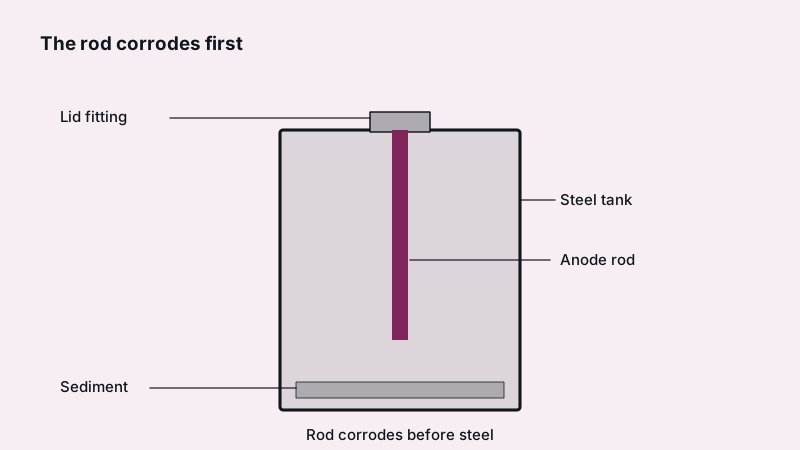
Inside every steel tank water heater hangs a metal rod that is meant to be eaten. Corrosion goes after the rod first. Once it has dissolved, the steel wall becomes the next target and rusts from within. Swapping it is the cheapest piece of water heater repair there is, $125 to $300 with labor included, according to Fixr, and it can stretch a heater's life by years. A local plumber can inspect yours; the quote request starts that.
What does an anode rod actually do inside the tank?
It is a rod of magnesium, aluminum or zinc on a steel core, threaded through a fitting in the tank's lid. Because those metals corrode more readily than steel, they take the attack first. Engineers call this a sacrificial anode, and the same idea protects boat hulls and pipelines.
The rod works until the soft metal is consumed. After that, the exposed steel core and the tank wall take over as the target. Pinhole leaks at the bottom seam are the usual end of a heater whose rod ran out years earlier. Replacing the rod resets the protection, as long as the tank walls are still sound.
When is the rod due for replacement in a south Orange County home?
Maintenance guides tend to say check it each year or two and replace somewhere between year three and year five, earlier if the water is hard or a salt softener is in the house. Orange County water is typically hard, and a household softener tends to speed the rod's wear, so those homes sit at the short end.
Treat the interval as a rule of thumb, since water chemistry and usage vary. The practical test is the rod itself: pulled out, it should look like a thick rod with metal still on it. When the core wire shows along much of its length, or the rod is thinned and pitted, it is done. Your water district's quality report states local hardness, and the scale side is handled in hard water scale prevention.
Which signs suggest the rod is gone or the water smells?
A sulfur smell that shows up only in hot water is a classic hint, because bacteria in the tank can react with a magnesium rod. Popping or rumbling from sediment, rust-brown hot water, and a heater past its eighth year also point toward a worn rod, though they overlap with other problems.
Do not blame the rod for everything. A pilot problem, a failed element or a weak thermostat produce their own symptoms. If the hot water is gone entirely, start with no hot water at home. A smell is cheaper to test: a plumber can swap in a different rod material, often aluminum with a zinc component, or flush the tank.
What happens during the swap itself?
First the heat source goes off (breaker, or the gas control set to off), the cold supply is closed and a hot tap opened. A few gallons drain out so the water sits below the rod. A big socket, frequently 1-1/16 inch, breaks the hex head loose and the old rod lifts out. The new rod goes in with thread tape; the tank refills while a hot faucet stays open to vent trapped air.
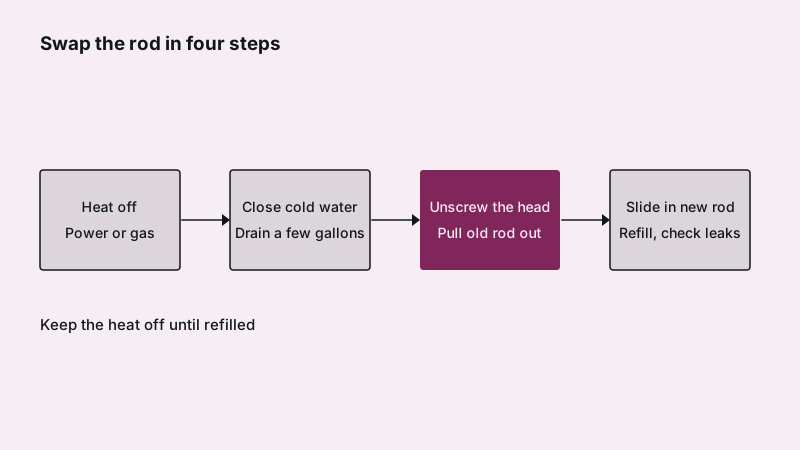
Three things trip people up: the head is often torqued very tight, ceiling clearance may leave no room to lift a rigid rod, and drained sediment can clog the valve. A flexible, segmented rod solves the clearance problem. Gas models also need care around the vent and the flue, so a plumber handles them more often than homeowners do.
Can I do it myself, and when should I not?
A handy owner can manage it on an accessible heater in decent shape. The hazards: a head that has seized and rounds off, a cracked fitting, and a warranty complication if the job goes wrong. Seized rods on old tanks are where a plumber earns the fee, because a leak at the fitting can end the heater's life.
Gas control and venting are regulated work, so stop and call if either is disturbed. On permits: replacing a whole heater in California normally needs one, while a rod swap is ordinary maintenance that usually does not. Confirm with the city for your case; water heater permits explains the process.
What does the job cost, and when is a new heater smarter?
Fixr lists an anode rod replacement at $125 to $300 including labor, and a new tank at $600 to $2,000, so a rod makes sense on a heater that is still young, say under eight years, with a dry base.
If the heater is ten to twelve years in, or already damp at the base, skip the rod and budget for a replacement; a tank that gives way in a garage or closet can lose far more than the average household leak EPA cites, above 9,300 gallons annually. Lifespan questions go to how long heaters last and the whole-heater bill to water heater replacement cost. The home page shows the other heater services.
Common questions
Does a tankless heater have an anode rod?
No. A tankless unit has nothing to store water in, so nothing needs a rod. What it fights is mineral crust on the heat exchanger, a hard-water habit, and the manual sets the descaling schedule. For that kind of heater the relevant page is tankless repair cost.
Which rod material is best for hard water or for smell?
Magnesium protects most strongly in softer water yet can feed that sulfur smell. Aluminum often survives longer in hard water, and a zinc-aluminum blend is sold to cut odor. Powered anodes rarely need replacing and cost more up front. A plumber can match one to your water.
Will a new anode rod stop a leaking tank?
No. It slows future corrosion and does nothing for a hole already in the steel. Water dripping from the tank body means a new heater. Drips from a pipe joint or the relief valve can be repaired, and pressure relief valve replacement covers one of them.
Should an aging heater get a new rod at all?
Only when the tank is sound. A fresh rod inside a rusting tank buys little. Have the plumber look for rust near the base, read the age off the data plate, and say whether the rod, a new element or a new heater deserves your money.
Sources
- Fixr, Water Heater Repair Cost (anode rod, new tank)
- Wikipedia, Sacrificial anode
- Wikipedia, Water heater
- Wikipedia, Hard water
- EPA WaterSense, Fix a Leak Week
- CSLB, hire a contractor
- Published water heater maintenance guides, checked November 2026
Updated