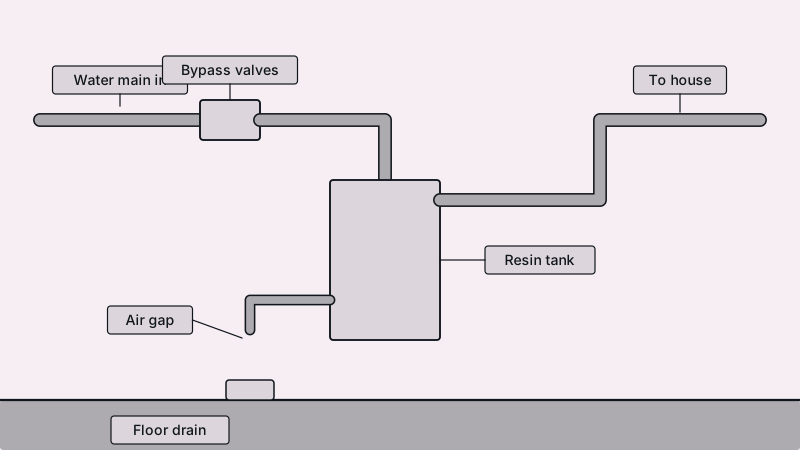
A typical installed softener in a Mission Viejo house can land anywhere from about $650 to $3,000 for an ion exchange unit, according to Fixr's national figures, and the installer's labor is the smaller part: the tank and valve head are the bulk. A garage with a ready-made loop, a nearby outlet and a floor drain sits at the cheap end. This page is the price companion to our softener installation overview. For a written number for your house, use the quote request.
What does the whole softener job add up to?
Fixr's national figure for a complete installed ion exchange softener, the salt-based kind, is $650 to $3,000. The unit alone is $500 to $2,000 of that, and labor is $150 to $1,000. Replacing an old softener that already has a bypass and drain is much cheaper than starting a new spot from bare pipe.
Treat the range as a starting point, not a quote. It moves with unit size, brand, and how much pipe has to be cut. What you actually pay is whatever the written quote says. Below, the spending is split by component.
| Component | Fixr national range | Main driver |
|---|---|---|
| Softener unit (tank, resin, control head) | $500 to $2,000 | Capacity, brand, metered or timed |
| Installation labor | $150 to $1,000 | Pipe access, bypass valve, hose and clamps |
| Softener loop, if the house has none | $600 to $2,000 | Pre-plumbed pipes, valves and drain on the garage wall |
| Replacing an existing unit, labor and unit | $700 to $1,000 | Existing bypass and drain already in place |
| Old unit disposal | $50 to $100 | Added when replacing a unit |
Is a pre-plumbed softener loop worth paying for?
A softener loop is a pre-plumbed set of pipes, usually on the garage wall, with valves and an outlet and drain box so a unit can be added later. Installing one is cheaper while the house is open or the pipe is accessible, and Fixr lists a softener loop at $600 to $2,000 when a house has none. Skipping it means later cutting into the main line.
Having a loop already makes the later softener job quick, since the plumber connects hoses and sets the head. If your house has one, mention it when you ask for quotes. The how a softener installation goes page shows the steps.
Does the badge on the tank change the quote?
Mostly through the equipment, yes. Kinetico and Culligan are dealer brands, Rheem's AquaSure line shows up at home centers, and Costco stocks units too. Each prices the tank and the setup differently. Some bundle setup into one number, others sell the unit and leave installation to you.
No published installed price for one single brand was available to us, so read the brand differences as a direction and not a figure. Ask each seller what installation includes: bypass, drain, hoses, first-time setup, and removal of the old unit.
Which site conditions at a Mission Viejo house push the price up?
Four things, mainly: where the unit goes, the size, the drain, and the water pressure. A garage unit near the water heater needs the shortest pipe run. A unit in a side yard needs weatherproofing. Larger houses and higher hardness call for more capacity, and capacity costs more.
Drain and power are the surprise items. A softener flushes brine to a drain, so it needs an air gap and a place to discharge. Certain California communities restrict salt discharge from softeners, so phone the sanitation agency or city before buying. The city's utilities page names four water districts that serve Mission Viejo: El Toro, Moulton Niguel, Santa Margarita and Trabuco Canyon. Every district issues a yearly water quality report that lists hardness for its service area.
What capacity do I need for my water hardness?
Start with the hardness number in the district's water quality report, expressed as mg/L or as grains per gallon. On the USGS scale, 121 to 180 mg/L counts as hard and anything above 180 as very hard. Next, count people. Harder water and bigger households exhaust the resin sooner, so they call for a larger tank.
Too small, and the unit regenerates constantly and burns salt. Too big, and the extra capacity costs money on day one and then idles. The seller or plumber sizes it from hardness, occupants and bathrooms.
What will it cost to run once it is in?
Salt, a trickle of electricity and the water used in regeneration make up the running bill. In an ion-exchange unit, resin beads trade hardness minerals for sodium, or for potassium when potassium chloride is the regenerant. Wikipedia notes that potassium chloride costs more, and that the flushed-out minerals normally go to the sewer.
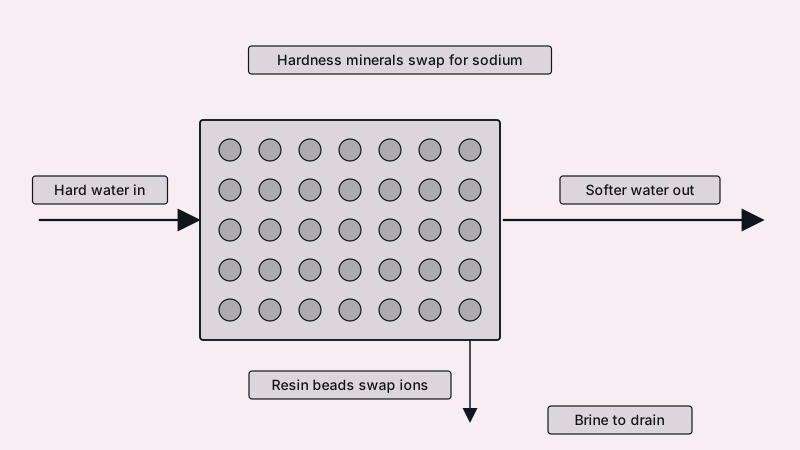
Salt-free conditioners cost less to run and do not discharge brine, but they condition scale rather than remove hardness, so results differ. Compare what you want to stop: spots and scale, or soap lather. Scale already caked on fixtures stays until someone dissolves it (the scale removal guide shows how), and stopping it from returning is a separate topic, preventing scale.
Will the water bill notice a softener?
Slightly. Every regeneration cycle draws some water, and the amount depends on the model. A jump after installation more often means a stuck regeneration valve than a design flaw. The checks are on the page about a softener and a high water bill, and the longer list of suspects sits under a high water bill.
Do I need a contractor license or a permit for this?
California requires a state-issued contractor license from $1,000, parts included, and a fitted softener often passes that mark. Whether a permit applies depends on the jurisdiction, so start with Mission Viejo Building Services, then see whether the plumber agrees. On a home improvement contract, no more than 10 percent of the price or $1,000 may be asked up front, whichever is less.
The quote should spell out model, capacity, drain method and inclusions.
Common questions
What does a basic salt unit cost fitted?
Fixr lists a single-tank installed softener at $650 to $1,500, with labor of $150 to $1,000 inside that. A simple swap into an existing loop or bypass costs less. Costs rise with a long drain run, a new outlet, or a larger-capacity tank. Ask for the model and capacity on the quote.
Can I save by buying one and fitting it myself?
The unit may cost less, but the connection still means fittings on the main, a drain and an outlet. A slip can flood a garage or void a warranty. Confirm the permit question with the city and keep receipts, or buy the tank and bring in a plumber just for the hookup.
How long will the taps be dry?
Plan on a few hours for a garage install when the bypass and drain are already there. A new loop, a longer drain or an added outlet stretches the visit, and the supply stays closed while the plumber makes the tie-in.
Does a softener need its own drain?
Yes. Salt-based units send brine and rinse water out at each regeneration, through an air gap that stops wastewater from siphoning back. A floor drain, utility sink or washer box can serve. A long run for the drain is one of the extras that raises the quote.
Budget sorted? plumber across Mission Viejo explains the rest of the job.
Sources
Updated