Picture a backflow assembly as a turnstile for water: flow goes in, and nothing contaminated is allowed to drift back out into the public supply. Businesses with irrigation, fire sprinklers, boilers, car wash bays or kitchens usually have at least one, and water districts commonly ask that each be tested on a regular schedule. If you run an emergency commercial plumbing call-out, this is the planned, calm sibling of that work.
Which commercial properties need backflow testing?
Any property where something could push contaminated water the wrong way: irrigation systems with fertilizer injectors, fire sprinkler feeds, chilled and hot water loops, restaurant dish machines, salons, dental offices, laundries, car washes, and buildings with a separate landscape meter. Your water district sets the rule for the address, so the notice letter or the district's cross-connection office is the final word.
If you have never seen a test tag on the assembly, look for a metal device on the supply side, often sitting near a meter or beside a landscape bed. A tag with a date, serial number and tester details is the sign of earlier testing. No tag usually means either an overdue test or an assembly that was never registered with the district.
What does the tester actually do on site?
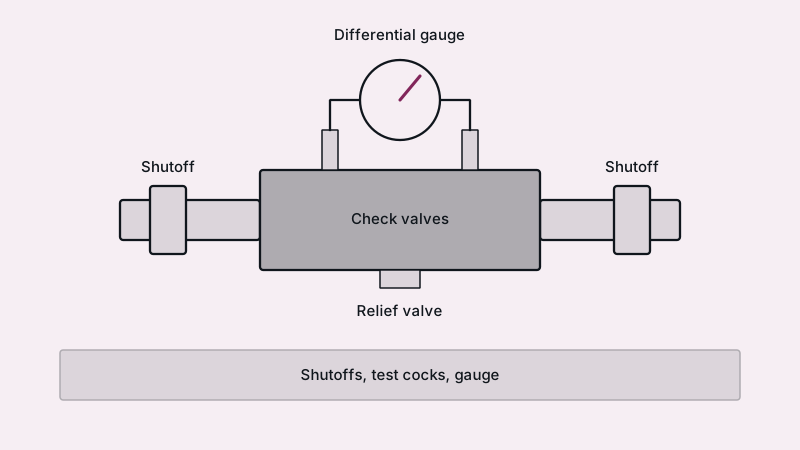
The tester closes the shutoffs at each end of the assembly, hooks a differential gauge onto the small test cocks along its body, and reads whether every internal check and relief valve holds its rated pressure. The test takes under an hour on a single assembly in typical conditions, though access, size and the number of assemblies change that. Afterward, a report goes to the district.
You will lose water to that line briefly, so tell staff and customers, and schedule around opening hours when a restaurant or clinic cannot go dry. Irrigation assemblies are the easiest to schedule. Fire sprinkler assemblies bring in extra notification, since the system is out of service during the test.
What type of assembly do I have, and does it change the test?
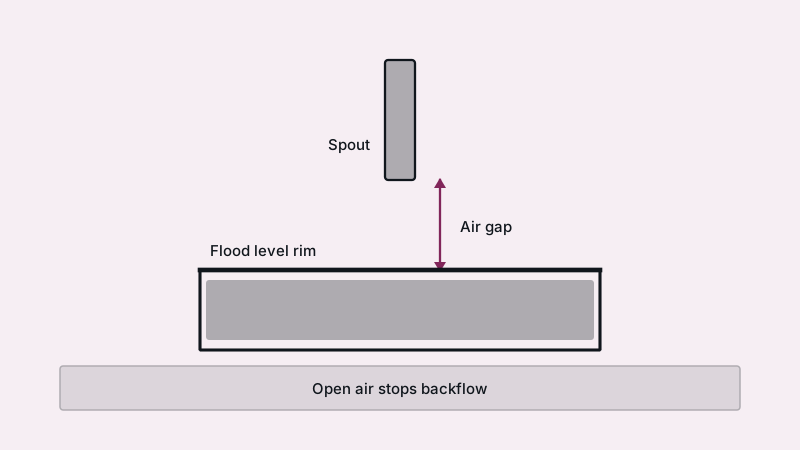
Mechanical types differ in design: a reduced pressure principal assembly, a double check valve, a pressure vacuum breaker and an atmospheric vacuum breaker each get tested in their own way. The general reference on backflow devices describes a plain air gap as the simplest protection, with mechanical valves taking over where a gap is not practical.
Your tag or the nameplate on the body tells the type. Higher-hazard connections, such as chemical injection or boilers with additives, usually call for the stronger assemblies. If you are unsure, photograph the device and send it with your price request and we can pass it to the plumber ahead of the visit.
What does a failed test mean for the business?
Failure means something inside is leaking or sticking: commonly a worn check disc, a fouled seat or a weeping relief valve. Plenty of these are cured during the same visit with a rebuild kit, followed by a second test. If the body is cracked, corroded or obsolete, replacement is the route, and a permit may apply.
Districts commonly give a short window to repair and retest, so do not leave a failed tag sitting. Ask the plumber for the result in writing, the cause, and a quote for the repair separately from the test so you can compare.
Does my district or the city handle the paperwork?
The water district runs the cross-connection program and receives the test report, so the district's rules decide what form is needed and by when. For replacing or moving an assembly, the permit office is the City of Mission Viejo Building Services Division, 949-470-3054. Parts of Mission Viejo, and neighboring communities, are served by different districts, so check which one bills you.
Also remember the knock-on effect inside the building. The city's water heater handout points out that a backflow device turns the supply into a closed system, which often means an expansion tank is needed at the water heater. A new or replaced assembly can therefore change the hot water side as well.
How do I choose who tests and repairs it?
Confirm that the person testing appears on your water district's list of recognized backflow testers, and check the plumbing contractor's number on the CSLB lookup. State law requires a contractor license once work reaches $1,000, which a replacement crosses quickly. Deposits stop at one tenth of the price, never above $1,000.
Get the test, the repair and any retest priced as separate lines. More depth sits in backflow testing services and the walkthrough of the test procedure. Pricing questions go to what testing a device costs and commercial hourly rates. When you are ready, a price request starts the visit.
Common questions
How frequently must it be retested?
California water districts commonly ask for a yearly test, plus another following installation, repair or a move. Some high-hazard sites are asked for more. Your district's letter states the interval for your address, so follow that over general advice. Keep every report in a binder, because inspectors and insurers may ask for them.
Can in-house maintenance staff run the test?
Not unless the person is recognized by your water district as a backflow tester. The test needs a calibrated gauge and trained handling, and the district usually only accepts reports from people on its list. Staff can help by keeping the assembly accessible, clear of vegetation and above flood level.
What else does a commercial plumber handle?
Commercial plumbers cover restroom fixtures, water heaters, grease interceptors, drain lines, gas piping, boilers, water treatment and tenant improvements. They also handle code inspections on larger systems. The work differs from home plumbing in pipe size, pressure and the number of people who depend on the system.
Do I need to shut my business to test the assembly?
Often not for long. Most tests need the water off to that one assembly for a short stretch. You can usually pick quiet hours. Restaurants and clinics are the sites that need a plan, and fire sprinkler assemblies come with notification steps before the line goes out of service.
Every service and price guide is on the plumber guide for Mission Viejo.
Sources
Updated