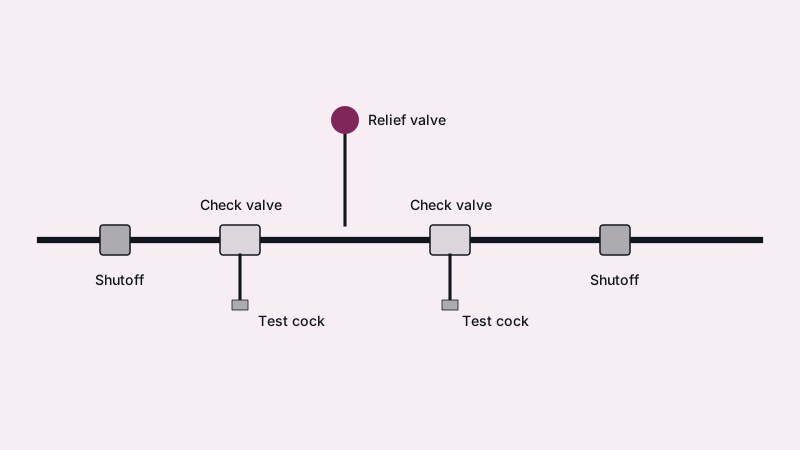
Homeowners do not run backflow tests. A tester arrives with a differential gauge kit, isolates the assembly, and logs how both check valves and the relief valve respond. Your water district tells you when the test is due, and the results go to them. The permit side is a separate process through the city. Both topics sit inside the code-and-inspection side of plumbing, which our permits, codes and gas work guide introduces. A visit can be requested through the quote form.
What is the tester looking for?
The test proves the device can still stop dirty water from sliding backward into the drinking supply. Wikipedia describes a typical assembly as having test cocks and shutoff valves, and says it must be tested when installed, after repair or relocation, and periodically. Many U.S. places require that yearly.
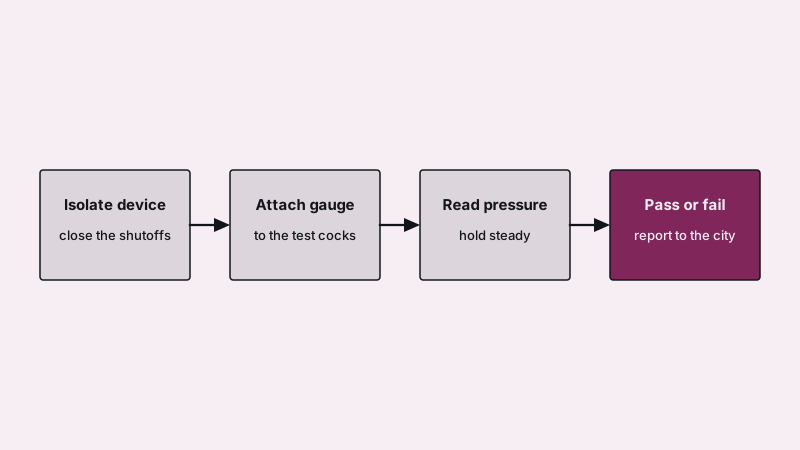
The tester screws hoses from the gauge kit onto the test cocks and reads pressure drops across each check valve. A reduced pressure device also has a relief valve between the checks, and the tester watches the pressure at which it opens. Readings are compared against the manufacturer's and the water supplier's minimums, and a failing part is replaced or the device is rebuilt.
Which homes in Mission Viejo have a backflow device?
The usual ones are irrigation systems, fire sprinkler lines and any property that takes recycled water. A pressure vacuum breaker stands above ground on a sprinkler line, and a reduced pressure assembly sits near the meter on larger or higher-hazard connections. A plain house with no sprinklers may have only a dual check valve at the meter, which cannot be tested.
Unsure? Look for a bronze or brass body with two handles and a few small test ports, or ask the supplier named on your bill. The city lists El Toro, Moulton Niguel, Santa Margarita and Trabuco Canyon water districts, and which one serves you depends on the address.
How often is a backflow test required, and who sends the notice?
Your water supplier sets the schedule, and a yearly test is the common one. The supplier mails or emails a notice with a deadline, and the tester's report goes back to the district, often through an online portal. We cannot give you your date, because it differs by district and by device, so look at the notice or call the district.
Ignoring a notice is the costly option. Districts can pursue it as a compliance issue, and an untested device is a gap in the protection the rules exist to provide. Costs for the test are on the backflow testing cost page.
Can I test a backflow preventer myself?
No, not in a way the district will accept. Water suppliers normally accept reports only from testers they recognize, and the gauge kit itself needs regular calibration. What you can do is keep the device accessible, clear of shrubs, and not buried in a box full of water.
If the device leaks from the relief valve, shut the irrigation supply and book a plumber. What we arrange is listed under backflow testing services, and a business with a fire line should read about commercial backflow testing.
How does a Mission Viejo plumbing permit get issued?
Apply online. Mission Viejo Building Services states that all permits and inspections must be submitted and scheduled through its online self-service portal, and that everyone on the permit needs an account. Questions go to 949-470-3054. The city's counter runs Monday to Friday, 8 am to 4 pm, closed noon to 1 pm.
The city's page does not list which plumbing jobs need a permit, so ask before you start. In general, replacing a water heater, a gas line, a repipe or a sewer lateral involves one. A faucet swap usually does not, but confirm.
Who is allowed to pull the permit?
That follows from who is doing the work. A hired contractor ordinarily applies under their own state license number. A homeowner doing the work personally may be able to apply in the owner-builder category, though California's contractor board sends you to the local building department for the rule and attaches warnings to it.
Because California sets $1,000 as the line for needing a contractor license, big jobs end up with a license holder regardless. When a plumber is arranged for you, ask who is applying and which day the inspector is due.
What goes on the application, and do I need drawn plans?
Expect to enter the property address, owner and contractor details, what is being done, and what it costs. Smaller jobs, a tank swapped for the same size, often need no drawings, but ask Building Services, since requirements vary by job and the city decides. A repipe or an addition may need a sketch showing fixtures and pipe routes.
If a plan is needed, a simple diagram works: the floor layout, each fixture, the pipe sizes and materials, and the water and drain connections. Do not guess. The permit technician can say what level of detail the inspector expects.
What happens at the inspection?
An inspector checks the finished work against the code before the walls are closed or the system is put to use. For plumbing, that usually means pressure or leak tests on the pipes, correct fittings, straps on the water heater, the relief valve discharge, and gas piping tested for leaks. Inspections are scheduled online through the same portal.
Keep the work uncovered until it has passed. Failing is routine and means a short correction list. A water heater permit and gas piping rules each have their own checks.
Common questions
How do I fill out a plumbing permit application?
Register on the city's online portal, start a plumbing permit, and enter the address, contact details, work description and job value. Add the contractor's state license number if one is hired. Upload any plans the city asks for. Pay the fee, then schedule inspections through the portal.
What plans do I need for a plumbing permit?
It varies with the job. Swapping a water heater for an identical one often needs none, while a repipe or remodel may need a fixture and pipe layout. Ask Mission Viejo Building Services at 949-470-3054 before drawing anything, because the inspector wants only the detail the job calls for.
Is the annual test part of the permit?
No. A permit covers installing or altering the device. The periodic test is a water-supplier requirement, with its own notice, tester and report. A new backflow assembly will generally be tested at installation as well, and that result goes to the district.
RPZ or double check, what separates them?
In a reduced pressure zone assembly a relief valve sits between two checks, which suits higher hazards. A double check assembly has the two checks but no relief valve and serves lower hazards. The water supplier decides which one a connection needs.
The rest of our guides start from plumber mission viejo.
Sources
Updated