One California guide puts residential plumbers in Los Angeles and Orange County at roughly 95 to 175 dollars an hour, and it does not cover commercial work or after-hours calls. Commercial jobs and urgent calls usually cost more. The emergency commercial plumbing page covers urgent calls, and a quote request names the real number for your building.
What hourly rate is reasonable for commercial plumbing around Mission Viejo?
Guides disagree because they measure different things, but the pattern is steady. One California guide shows about 95 to 175 dollars an hour for Los Angeles and Orange counties, and that guide does not cover commercial work. Commercial work sits above residential because of insurance, larger tools, permits and liability.
Every figure here is a yardstick. Most were gathered from plumbing company and lead-generation pages, not government data. The only official number in this area is the wage, and a wage is not a rate: the federal labor statistics bureau listed a median of 30.67 dollars an hour for the trade, plumbers, pipefitters and steamfitters together, as of May 2025. What a business bills covers payroll tax, insurance, vehicles, tools and overhead on top.
Why is the rate on a quote four or five times a plumber's wage?
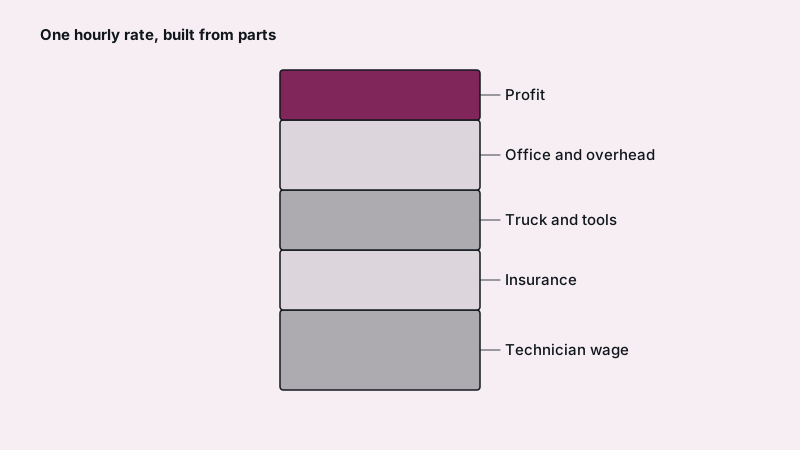
Because the wage is one cost among many. A billed hour carries payroll taxes, workers' compensation, liability cover, a truck, tools, dispatch, the office and the time between jobs that nobody pays for. Shops often price from the true cost of keeping a person on the road, then add margin.
A rough way to think about it, not a formula from any source: take the wage, add the burden for taxes and insurance, add vehicle and overhead per billable hour, and expect many hours in the week to be unbillable. That arithmetic is why a 30 dollar wage becomes a triple-digit billing line. If someone offers a rate that seems far below the pack, ask about insurance and the license number.
How do journeyman, master and apprentice rates differ?
Apprentices bill lowest, journeymen sit in the middle, and a senior or lead plumber who runs the job and signs the paperwork bills most. In California the trade uses apprentice and journeyman levels, and the business holds the contractor license. The title "master plumber" is used in some states and in marketing, but California contractor licensing does not use it as a license class.

So when a page quotes a "master plumber hourly rate", read it as a senior rate. Commercial quotes often list labor classes separately, for example a lead at one rate and a helper at a lower one. Ask who is coming, because a two-person crew at two rates can finish faster than one person at a lower figure.
How much extra is a night, weekend or emergency call?
We found no reliable published figure for emergency commercial rates, so we print none. Evening, weekend and holiday work usually bills above the normal rate, and the quote should state the multiplier. A grease trap overflowing in a kitchen on Friday night is a genuine emergency; a dripping tap in an empty office is not.
Our desk works weekdays, nine to five. Once the office closes, shut the building main, or the branch valve feeding the trouble, and photograph the damage. For a gas odor, step outside and ring the gas utility, SoCalGas; a flood or fire risk goes to 911.
Are commercial jobs billed hourly, by the day, or as a flat price?
Small repairs and diagnostics are usually hourly, with a minimum. Defined projects, such as a restroom rough-in or a water heater swap, are quoted flat. Large jobs may be quoted by milestones. A flat price protects you from time overruns, and hourly protects you if the scope is unclear, so use whichever fits how well the problem is understood.
Usual add-ons on a commercial quote: a trip charge, parts at cost plus markup, equipment such as a drain camera or jetter, permit fees, disposal, and after-hours work. If a business needs a sewer camera, ask whether that is part of the hour or a separate line. Backflow devices at commercial sites need yearly tests, so ask what that costs too: see commercial backflow testing.
What should I settle with a contractor before commercial work starts?
Get the license number and run it through the state board lookup. Request proof of insurance. Then find out if the rate has a minimum, if drive time is billed, how parts are marked up, and whether the figure is an estimate or a cap. Have the replies in writing before anyone starts.
Mind the deposit too. California's home improvement rules limit a down payment to ten percent or a thousand dollars, the lesser of the two, and a business owner should not assume that protection covers a commercial contract, so agree payment terms in writing and avoid paying everything up front.
How do I compare commercial rates with household rates?
Judge the total, not the hour. A bargain rate that needs a long diagnosis and two trips may cost more overall than a pricier hourly figure that finishes in one. Compare residential pricing on the plumber cost page, the cost per hour page and the service call fee page.
For a one-off look at the plumbing of a building you may buy or lease, see the plumbing inspection cost figures too. Older commercial pipe in Mission Viejo's 1970s and 1980s business parks may mean more time opening walls, which is the single biggest reason an hourly job runs long.
Common questions
Is there one standard hourly price right now?
Not a single one, no. One California guide lists about 95 to 175 dollars an hour for Los Angeles and Orange counties, and rates elsewhere differ. The honest answer is a band, and a good plumber explains which part of it you are in.
Did hourly rates change since 2022?
Yes, most guides show upward drift since 2022, driven by wages, insurance and parts costs, so a 2022 article understates today's figures. Use pages dated in 2026, and expect the business to quote its current rate card, not an old average.
Is an online hourly-rate calculator reliable?
A calculator turns hours, rate and parts into a rough budget, yet the hours are the unknown, and only a site visit answers that. Use it to sanity-check quotes you receive, and for any larger job ask the contractor for an estimate on paper.
Is the first hour priced higher than the rest?
Often. Many shops set a minimum, commonly one hour, and some add a trip charge that gets subtracted from the job if you approve it. Ask whether the minimum runs longer than an hour, and whether drive time to and from your site counts toward the bill.
Who pays for permits on a commercial job?
The permit fee belongs on the quote as its own line. The contractor usually applies for it, and the city's Building Services Division can tell you what applies. See that the permit is under the contractor's name and an inspection is booked.
Prices are one part of the job: plumber across Mission Viejo covers the rest.
Sources
Updated