A. O. Smith has a big footprint in Southern California garages, and its heaters usually fail in familiar ways: ignition trouble, a burned-out element, a tired relief valve, a bed of sediment, or a rusted-through tank. Ignition, element and valve are repairs. A rusted tank is the end of the heater. You can narrow the cause in ten minutes by reading the rating plate, and what follows shows how, then splits the work between you and a plumber. Other brands are handled on the water heater repair hub.
What does the label on my A. O. Smith heater tell me?
Fuel type, capacity, input rating, model and serial number. With those, you can describe the heater on the phone, order parts or look up warranty terms. The model reveals gas or electric and the size. The serial reveals the build date.
Read the serial like this: on most recent units, the first four digits are the year and the week. A code beginning 1532 means week 32 of 2015. Heaters built before about 2008 often start with a letter, and the year follows it. Published decoders say the same pattern applies to sister brands such as State, American and Reliance.
Why it matters: a heater past roughly a dozen years is usually a better candidate for replacement than a big repair. Check the warranty card too, because terms vary by model and by whether the original owner registered it.
Why won't my gas A. O. Smith stay lit?
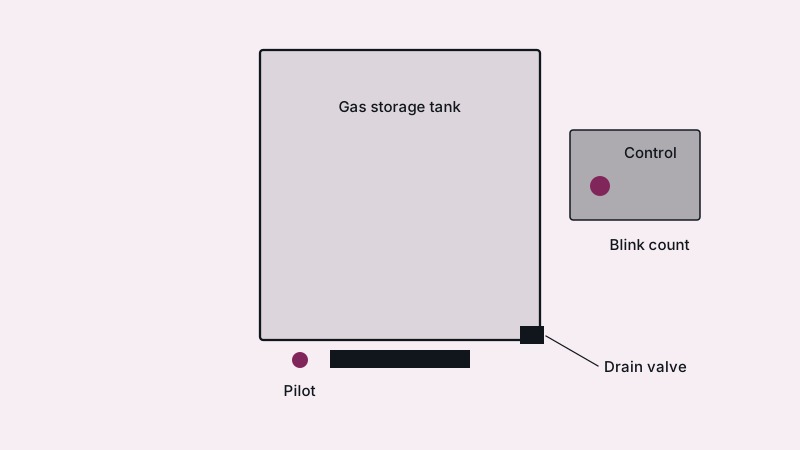
A pilot that keeps dying usually blames a weak sensing part, a draft, or a dirty burner. Newer gas models add a status light on the control that blinks in counts, and the count narrows the fault. A chart on the label near the control translates each count for your model.
Typical meanings, according to the maker's gas manuals, with a warning that codes differ by model:
- One flash is normal.
- A few flashes can mean the sensing voltage is low or the temperature limit tripped.
- A sensor or control-failure count generally ends with a new gas control valve.
- It can take up to a minute and a half of steady pilot before the light starts to blink.
A pilot that drops out right after a clean relight points at a worn thermocouple or thermopile, or a bad gas control valve. The relight sequence is in the pilot light repair guide.
Gas work stops at relighting. A gas smell means everyone exits first, and once outside you dial 1-800-427-2200 to reach SoCalGas. Danger to anyone means 911.
What stops an electric A. O. Smith from making hot water?
Usually a tripped high-limit reset, a failed heating element, a bad thermostat, or a breaker. An electric tank is heated by two elements stacked top and bottom. If the water runs warm but never hot, the lower element is often the one that failed. If there is nothing at all, the upper element, thermostat or power supply is suspect.
Kill the breaker before opening any access panel, and test with a meter instead of guessing. The replacement element guide explains the swap. If the high-limit button trips again after a reset, something is overheating, and that needs a technician.
Why is my A. O. Smith leaking, and is it fixable?
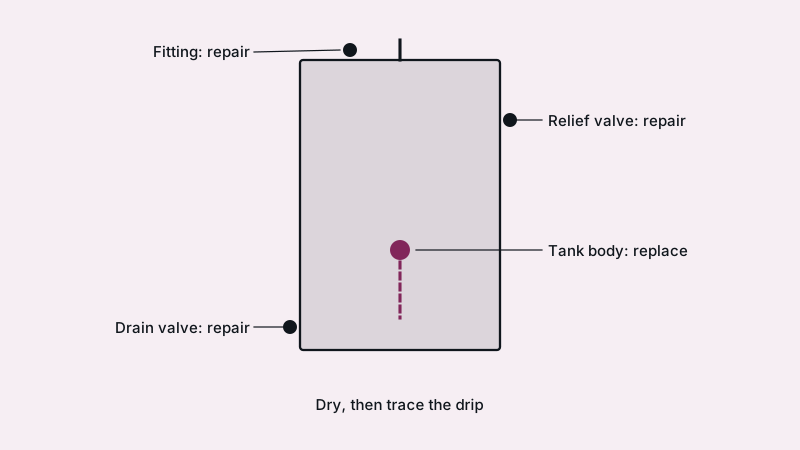
Location decides it. A drip at the relief valve pipe, a loose top fitting or a weeping drain valve can be repaired. Water that pours from the tank body, or seeps out of the jacket at the bottom, means the inner tank has corroded through, and that is a replacement.
Check in this order:
- Dry everything, then look at the top fittings and the supply lines.
- Study the relief valve, plus the discharge tube beneath it. A constant drip can signal high pressure or a worn valve.
- Look at the drain valve near the base.
- If the jacket is wet, or water pools beneath with every fitting dry, the tank itself is the leak.
Mission Viejo hillside areas can have high street pressure, which stresses relief valves. See pressure relief valve replacement and expansion tank replacement for related causes. For a burst or fast leak, shut the cold supply at the heater and call right away.
Rumbling, popping, or rusty water: what does that mean?
Those usually mean sediment on the tank floor or a worn anode rod. Hard water drops scale that rattles as it heats, and Moulton Niguel Water District reports have listed its treated water in the very hard range. A flush can help a young tank, and a new anode rod extends the life of one in decent shape.
Read anode rod replacement to judge whether the rod is worth swapping. If the heater is past its prime, flushing mostly delays the inevitable, and replacement is the better spend.
Which fixes can I do, and which need a plumber?
Owners can relight a pilot from the label's steps, press a limit reset once, check the breaker and flush the tank. Gas control valves, gas piping, vent changes and full replacements go to a contractor. A replacement typically needs a permit, and plumbing work worth more than $1,000 needs a contractor with a California license.
State rules also demand earthquake bracing on a water heater, and an inspector checks that the straps are on. Water heater permits in Mission Viejo explains who files.
At what point does a repair stop making sense?
Stop repairing once the tank leaks, the heater has run well beyond ten years, or the estimate nears the price of a fresh heater. Price the alternative in the replacement cost guide, and ask whether tankless would suit your household.
Common questions
Does an A. O. Smith heater need yearly service?
A yearly look pays off. Drain a few gallons to clear sediment, raise the relief valve lever for a second to test it, look for corrosion on the fittings and glance at the anode rod every few years. Local hard water makes each check count more.
Where is the serial number?
It sits on the rating plate, normally on the tank's side near the controls. Take a photo before you phone anyone. On most newer units its first four digits give year and week, so a plumber can place the heater's age and the parts it takes.
Is my heater still under warranty?
Maybe. A. O. Smith tanks carry limited warranties whose length varies by model, and parts coverage is usually shorter than tank coverage. Look at the card or the manual for your model, and have the serial number ready. Labor is often not covered.
Can I replace a gas control valve myself?
No. That part controls gas and the safety shutoff, and a poor connection is dangerous. Gas work is regulated here, so a contractor should swap the valve and then leak-test it. Skip the YouTube shortcut here: the safety shutoff lives in that part, and a loose fitting can leak gas.
Is it worth fixing a 12-year-old heater?
Often not, unless the repair is small, like a relief valve or element. A heater that age is near the end of the usual range, so a larger repair buys little time. Ask for both prices, repair and replacement, on the written quote.
This guide is one of many on plumber across Mission Viejo.
Sources
- A. O. Smith
- Water heating
- A. O. Smith residential gas water heater instruction manual and service handbook (status light and serial number sections)
Updated