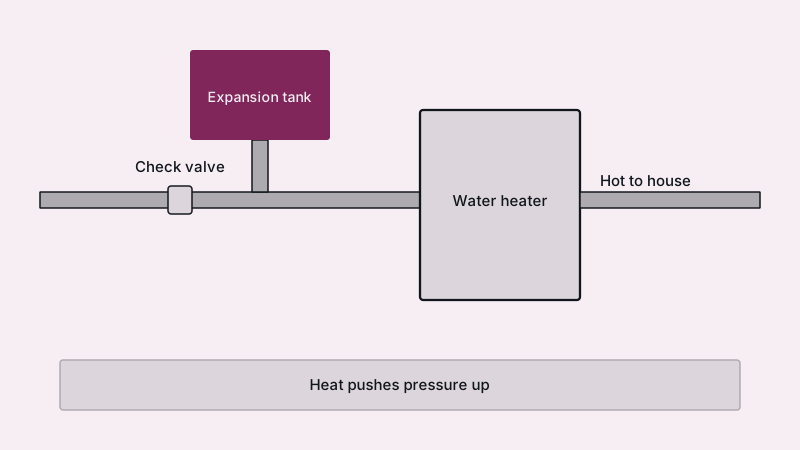
Heat a gallon of water and it grows slightly. If the house has a backflow device or regulator at the supply, the growth cannot push back into the street, so pipe pressure ratchets up whenever the burner or element cycles. A compact air-charged vessel with a rubber diaphragm soaks up the surplus. Once the diaphragm tears, the vessel floods and does nothing. It is one of the small parts discussed in the water heater service overview.
Why would a water heater be fitted with one of these?
Because many homes now have a closed system. Whatever blocks reverse flow (a check valve, a backflow device, a pressure reducing valve) converts thermal expansion into pressure. Mission Viejo's Building Services Division cites California Plumbing Code section 608.3 on its water heater handout for systems with a check valve or backflow preventer, so an expansion tank is often needed.
Regulators get specific wording. Code publishers summarize the 2025 California text as calling for a regulator when static pressure tops 80 psi, plus an expansion tank on cold piping downstream of each regulator. IAPMO's commentary notes that a pressure reducing valve is what closes the system. The edition your city has adopted is what an inspector applies.
How can I tell the tank has failed?
Four signs: the relief valve on the heater drips, the water pressure at a faucet reads above 80 psi, pipes bang when a tap is shut, or a faucet drips that never did. Then test the tank. Press the little air valve on the tank, much like a bicycle tire valve. Water squirting out means the diaphragm is gone.
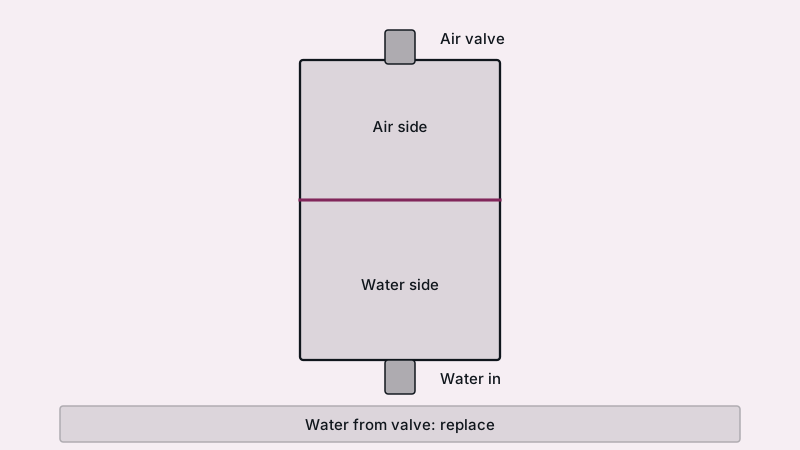
Knock on the shell too. A healthy tank rings hollow up high and dull lower down, while a waterlogged one is dull everywhere. A gauge on the outdoor faucet gives you static pressure. A high reading sends you to the regulator first; see where a regulator hides and adjusting the regulator. Banging pipes are covered in water hammer sounds, and a dripping relief valve in relief valve replacement.
What does replacing the tank involve?
After shutting the cold supply and bleeding off pressure, the plumber unscrews the old vessel, threads on a correctly sized new one and sets its air charge. The step that matters is matching the pre-charge to match the home's water pressure before it goes on, since a mismatch makes the tank useless. Then water is turned on and joints are checked.
Sizing follows the heater and the system, and manufacturers publish charts. Weight matters as well: a full vessel dangling from a short copper nipple strains the fitting, so many get a strap or support. It sits on the cold line close to the heater, usually with a tee and shutoff valve, and the swap often happens alongside a heater replacement. If you are comparing prices, the replacement cost guide shows where the code package fits.
Is this a job for an owner, and is a permit involved?
An owner can sometimes handle a like-for-like swap, but the pre-charge, soldering or threading, and support need care, and a mistake means leaks. A heater replacement normally involves a city permit, and an expansion tank added during it ordinarily falls inside that permit. Ask Building Services about the fee and whether a tank-only swap needs one before you start, and read permits for water heaters.
On a gas heater, California reserves any gas piping for contractors with the matching license. Notice gas? Step out, then reach SoCalGas at 1-800-427-2200. Mission Viejo's handout also mentions drain pans, valve placement and strapping for seismic safety, so a tank swap is a good moment to check those.
What does expansion tank replacement cost?
Fixr lists adding an expansion tank to a water heater job at $150 to $400 on top of the heater. By itself the swap is a short visit, and the figure depends on the tank, the access and any fitting that has to change. The true price comes only in writing.
Labor on a small job is mostly the visit itself plus the time to drain, fit and test. Ask the plumber to read system pressure and inspect the regulator on the same visit, since a failing regulator can ruin a new tank within months. Describe the job on the price request page, and a visit from a local plumber follows. The Capistrano Plumbing home page explains the process.
Common questions
How many years will one last?
No fixed number applies. They fail when the diaphragm leaks or the air charge is lost, and high pressure or heavy use can shorten life. A yearly check with a gauge and a press of the air valve catches trouble early. Water from that valve means a replacement is due.
Do I need one if my heater has a relief valve?
The relief valve is a safety backstop, not a substitute. Letting it open every heating cycle wastes water and wears the valve. In a closed system an expansion tank is often needed under the plumbing code, so a plumber will usually fit one. Some designs by a registered design professional may use an approved relief valve set at 100 psi or less instead, so find out which one the plumber intends.
What pressure should the tank be set to?
The air side should match the house's static water pressure before the tank is connected, and manufacturers print the setting on the tank. Test house pressure at an outdoor faucet. Many homes sit under 80 psi, the figure in CPC 608.2, and if the reading is above that, the regulator needs attention.
Can a bad expansion tank damage other things?
Yes. Repeated pressure spikes can stress the heater, valves, fixtures and supply lines, and shorten the life of a washing machine or dishwasher fill valve. Dripping relief valves, noisy pipes and leaking faucets are early signs. Fixing the tank is cheaper than replacing damaged parts.
Is a new tank part of a heater swap?
Frequently. When the old vessel has some years on it, or the system is closed, plumbers often fit a fresh one with the new heater because the labor overlaps and the part is a small share of the bill. Have the quote say whether the tank is included, and ask who sets the air charge.
Sources
- Fixr, 40-Gallon Water Heater cost (expansion tank adds $150 to $400)
- California Plumbing Code section 608.2, excessive water pressure (2025 edition)
- IAPMO, 608.2 Excessive Water Pressure code spotlight
- City of Mission Viejo, Building Services Division, water heater handout and fee schedule
- Published prices of 2026 water heater cost guides, checked November 2026
Updated