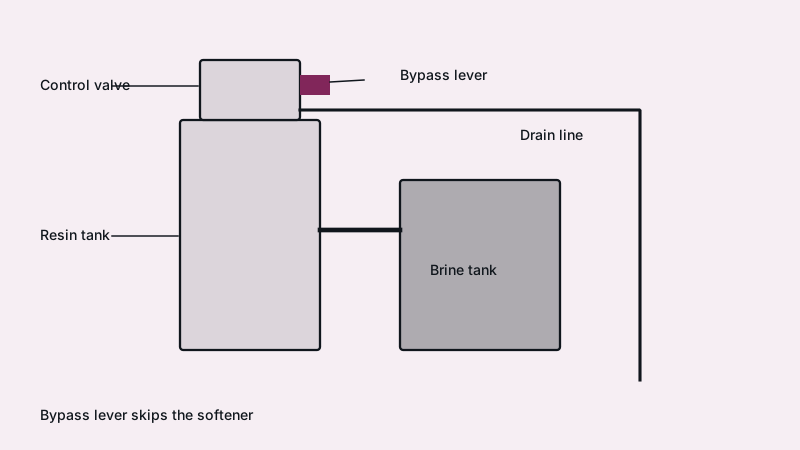
Yes, but usually not by much. Every regeneration cycle flushes brine and rinse water down the drain, so a softener always adds some use. A big jump on the bill points to a fault: a valve stuck mid-cycle, a timer set to regenerate too often, or a leak at the tank or valve head. A plumber can check it out, and a quick meter test comes first. Installation details are on the water softener page.
Does a water softener normally use a lot of water?
No, a healthy one adds a modest amount. A regeneration cycle recharges the resin bed with brine, then rinses, and that rinse water goes to the drain. The volume varies with the model, how mineral-heavy the supply is and the controller settings, so your unit's manual is the reliable source. A household that regenerates every few days will not see a dramatic change on a monthly bill.
Where use climbs is with old timer-based units that regenerate on the calendar, needed or not. Newer demand-initiated units regenerate by measured use, which saves water and salt. If your softener is more than a decade or two old, the controller is worth a look.
What faults make a softener waste water?
A few repeat offenders. A stuck or worn control valve can leave the rinse running; you hear water trickling at the drain line long after the cycle should have ended. A failed seal or cracked brine tank can leak. Resin that has worn out forces extra regeneration. And a wrong hardness setting makes the unit cycle far more often than needed.
Signs to look for:
- A hissing or trickling sound from the unit when no one is using water.
- A drain hose that is wet or warm to touch outside of regeneration times.
- Water around the brine tank or the base of the valve head.
- A clock or display that has been reset by a power cut, causing cycles at odd hours.
- Salt use far above what you used to pour into the tank.
Is the softener the culprit? A meter test settles it.
Close all taps, stop the dishwasher and washing machine, note the meter reading, and leave it two hours. Movement means water is going somewhere; the EPA describes this very check. Now set the softener to bypass with the lever or valve at the unit and run the test again. If the dial stays put, the softener was the source.
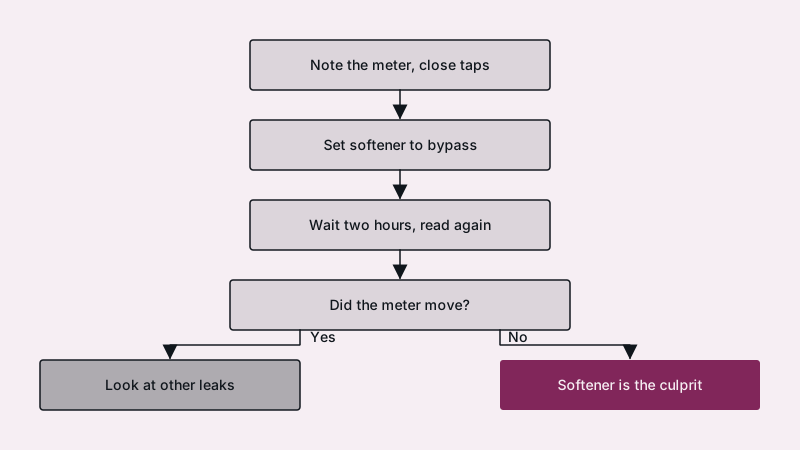
Note the time of any regeneration cycle too. Most run overnight. If the meter moves only at a set hour, it is a cycle and the question becomes how often and how long. Movement all day long means a continuous leak or a jammed valve, and that is plumber work.
Could something else behind the softener be the real cause?
Often. Toilets that run, dripping faucets, irrigation valves and underground leaks account for many mystery increases. The EPA's household figures: leaks waste more than 9,300 gallons a year on average, and about nine percent of homes lose 50 gallons a day or more. The softener gets blamed because it was installed recently, when the bill changed for another reason.
Drop some dye into each toilet tank, listen for hissing at fixtures, and compare this billing period to the same period last year, since summer irrigation changes everything. Rule these out first: see high water bills and the running toilet page.
Does hard water mean I should keep or remove the softener?
Hard water leaves scale in pipes, water heaters and fixtures, which costs money in other ways: heaters work harder, fixtures clog, appliances wear. A softener or another treatment can pay back in those places. Whether your water is hard is in your water district's published quality report, so look at it before deciding. Nothing here argues for removing a working softener.
If the goal is just lower bills, fix a fault first. If the goal is less scale without a regenerating unit, there are other approaches, but they differ in how well they work. Two further reads: preventing hard water scale and removing scale.
Are there local rules about softeners?
A number of California communities limit salt-using, self-regenerating softeners, since the brine burdens wastewater treatment. Rules differ by agency and are changing, so check with your water or sanitation district, or the city, before buying or replacing one. Also ask the installer how the unit drains: the discharge must go to an approved location.
For a new installation or a replacement, water softener installation cost explains the price drivers, and how a softener installation is done shows the steps. Work above $1,000 needs a California contractor license, so check the number before agreeing.
Common questions
What does one regeneration cost in gallons?
It varies by model and settings, so the manual and the maker's specifications are the right source, not a guess. A cycle commonly runs through brine, backwash and rinse stages. If your unit uses far more than its own specification says, or runs outside its schedule, something has gone wrong.
Why is my softener running all the time?
A control valve that did not return to the service position, a failed motor or a bad timer can leave it in rinse or backwash. Unplugging it will not fix a stuck valve and may make it worse. Put it in bypass to stop the drain flow, then call a plumber or the manufacturer.
Does softening help the water heater?
Over time it can: scale on an element or the tank floor wastes energy and shortens life. Savings vary with local hardness and heater age, so treat any promised percentage with suspicion. How often a heater is replaced explains the scale connection.
Should I turn the softener off when I am away?
Usually you can leave it. The unit regenerates only when its controller decides, and a demand-initiated model will do little with no water in use. If it is a timer unit, a long absence can mean cycles on resin that does not need them. Switching to bypass and unplugging is acceptable, though restart steps are in the manual.
This guide is one of many on plumber in Mission Viejo.
Sources
Updated