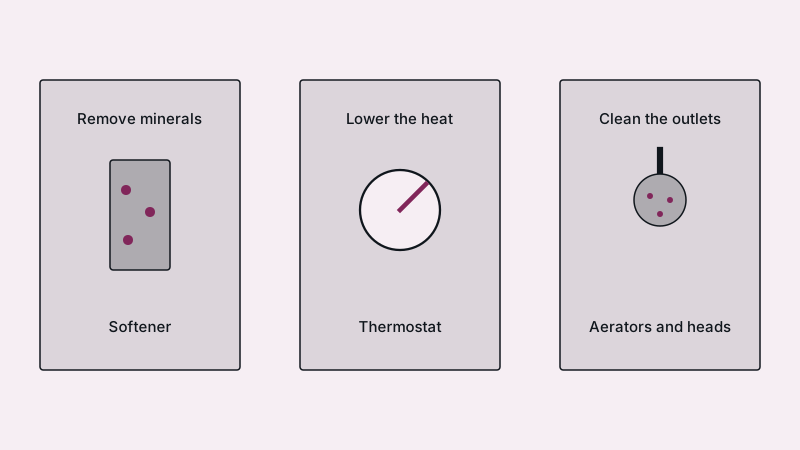
Three levers cut scale: remove minerals before they reach the heater (a softener), change the conditions that make them drop out (a lower heater setting and regular flushing), or clean the places where they land (aerators, showerheads, tankless units). Which you need depends on your hardness. Equipment options are on the softener installation page, while a quote begins at the request form.
The rest of our service sits on the home page; the numbers come first here.
What is hard water scale, and what causes it?
Scale is the chalky crust, mostly calcium carbonate, that forms when minerals dissolved in water drop out as solids. Heat speeds it: it forms fast inside water heaters, kettles and tankless heat exchangers, and it crusts faucet tips and showerheads where droplets dry. The cause is the water itself. The pipes did not do it.
South Orange County depends heavily on imported water, and imported supplies are typically on the hard side. We did not retrieve your district's own figures, so open the newest consumer confidence or water quality report from your district, where hardness is listed. Mission Viejo is served by more than one district, depending on the street.
Telling scale from corrosion is simple. White crust where water evaporates or gets hot is scale. Green or blue crust on pipes is corrosion, a different problem. For the cleanup side, see removing hard water scale.
What do ppm, mg/L and grains per gallon mean on my water report?
Water reports give hardness as mg/L (identical to ppm) of calcium carbonate, or in grains per gallon (gpg). The USGS draws its lines at 60, 120 and 180 mg/L: below the first the water counts as soft, above the last it counts as very hard, and the two bands between are moderately hard and hard. One grain per gallon is close to 17 mg/L. Hardness has nothing to do with pH.
That last point trips people up. The pH scale measures acidity and alkalinity; the hardness scale measures dissolved calcium and magnesium. Water can be hard with neutral pH. Others call it a "rating scale" or "number scale", but all describe the same mg/L or gpg value.
Quick conversion: divide mg/L by 17.1 and you have grains per gallon, so the very-hard line of 180 works out near 10.5 gpg. A home test strip gives a rough reading, and your district's report is the better number.
Which scale prevention methods actually work?
Three rest on solid ground: a salt-based softener that pulls calcium and magnesium out, a lower thermostat on the water heater, and scheduled flushing. Salt-free conditioners alter how crystals form without removing anything, and the evidence is mixed. Cleaning aerators and showerheads deals with the visible end.
- Softener. Resin beads inside trade calcium and magnesium out for sodium or potassium, and of all the options listed here, only this one lowers the hardness number. Details are on the softener installation page and the softener cost page.
- Anti-scale conditioner. Sold as salt-free, template-assisted or magnetic. They aim to stop minerals from sticking, not to soften. Results are debated, so ask the seller for independent test data and the return terms.
- Lower thermostat. Scale forms faster at higher temperatures, so keeping a tank heater at a moderate setting slows buildup. Confirm a safe setting for your household.
- Flushing. Draining a few gallons from a tank heater clears sediment. Tankless units need descaling by their maker's method.
- Cleaning. Soak aerators and showerheads in white vinegar to dissolve crust, then rinse.
California has local rules on salt-based self-regenerating softeners, and some places restrict them. Ask your water district before buying.
How does scale hurt a water heater?
A crust forms on the elements and the tank bottom, so the heater labors harder. Under a gas tank the layer separates flame from water; in an electric tank it can cook an element. Tankless units suffer more, since their narrow channels clog. Expect slow hot water, rumbling and a shorter life.
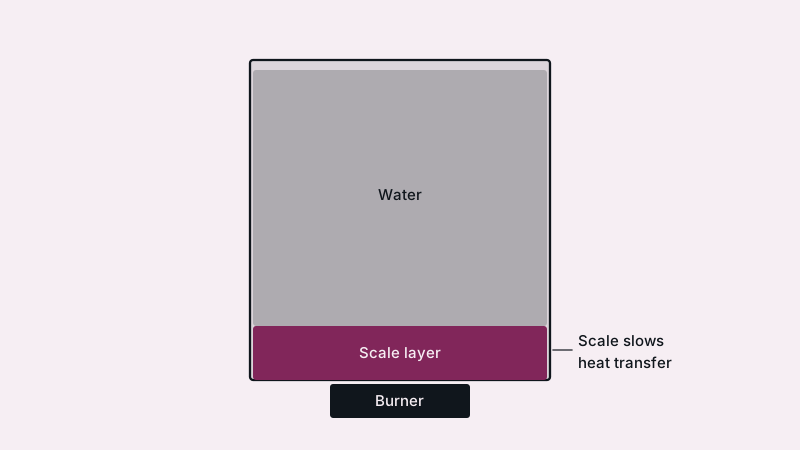
Rumbling or popping from a heating tank often means steam bubbling beneath scale. The wear that goes with it is covered under water heater lifespan and anode rod replacement. A tankless heater in hard water usually needs yearly descaling, which is worth planning before you buy: see tankless installation.
Will a softener push up my water bill?
Each regeneration cycle sends a little water to the drain, so a small rise is normal, though a well-set unit should hardly move the bill. A big jump suggests a valve stuck open or a leak; softener and water bill lists what to check.
Run the EPA meter test: with every tap off, a creeping dial points to a leak. Scale itself can also cause waste when it makes a faucet or toilet valve fail to seal.
What should I do first, step by step?
Start by learning your hardness, then match the fix to the number. Moderately hard water often needs only maintenance. Hard and very hard water usually justify a softener, especially if you plan a tankless heater. Do the cheap steps now: clean aerators, flush the heater and check the thermostat.
- Read your water district's latest quality report, or use a test strip.
- Clean aerators and showerheads, and descale the kettle.
- Flush the water heater and check the temperature setting.
- If hardness is high, ask a plumber to quote a softener, and compare it with the cost of replacing fixtures and heaters early.
- If you want a conditioner, get independent test data first.
Common questions
Where does hard water scale come from?
Minerals, chiefly calcium and magnesium, picked up as water travels through rock and soil. When the water warms or evaporates they drop out as solid carbonate. Pipes are not the source, though heat from a heater or hot line speeds the process along.
What number counts as hard water?
On the USGS scale, hard starts at 121 mg/L and very hard above 180, with moderately hard between 61 and 120. A report in grains per gallon converts by multiplying by roughly 17.1, so 7 grains per gallon is about 120 mg/L, the line between moderately hard and hard. Check which unit your report uses before comparing numbers.
Does hard water scale affect pH?
Hardness and pH are separate measures. The pH scale tells you whether water is acidic or alkaline, while hardness counts calcium and magnesium. Hard water can have a neutral pH. A test strip that gives both numbers can help you check which problem you have.
Do salt-free anti-scale conditioners work?
They are designed to change how minerals form crystals so they stick less to surfaces. They do not remove the minerals, and evidence for their results is mixed. If you try one, ask for independent test data, and watch your heater and fixtures over a year to judge.
Is vinegar safe for removing scale?
White vinegar breaks down light scale on aerators, showerheads and kettles. Never use it on natural stone, and never combine it with bleach. For a water heater, or for heavy buildup, follow the maker's own instructions or let a plumber take over.
Sources
Updated