Short of reading your policy, nobody can tell you for certain, and we are a plumbing service rather than an insurer. The common pattern is a pipe that fails suddenly reimbursed for the wet-floor damage afterward, while seepage that went on for months gets refused as maintenance. Details vary by company and form. Our part is the plumbing paperwork, which sits beside our leak repair service. If you need a plumber at the house, the quote form is the way in.
Will my own policy respond to a burst?
Frequently, if the failure is sudden and accidental. Wikipedia describes broad coverage forms that include accidental water damage and open-perils forms that cover anything not excluded, and it adds that insurers have restricted burst-pipe coverage, sometimes eliminating it. The declarations page and policy form tell you which type yours is.
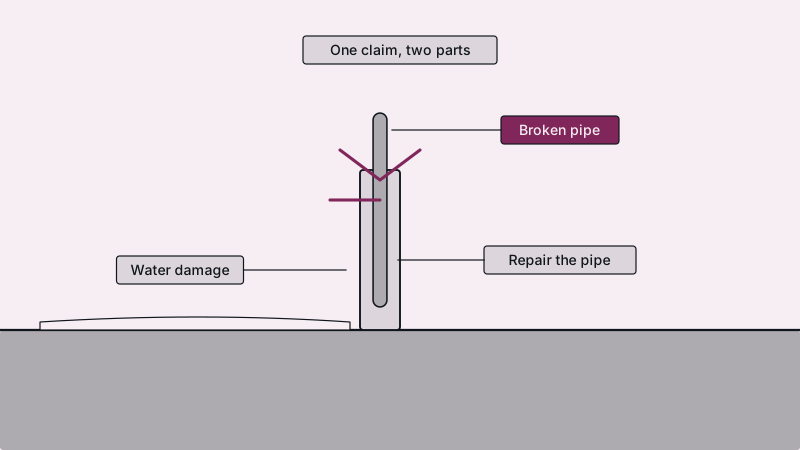
Most disputes split the claim in two: the water damage that follows, meaning floors, drywall and belongings, versus the cost of fixing the broken pipe. Some policies pay the first and leave the second to the owner, with different rules on opening up a wall. Ask the insurer how it treats each part.
Why is a flood from a burst not handled like a drip?
They see a drip as a maintenance failure and a burst as an accident. A burst floods a room within hours and is obvious. A slow leak works for weeks inside a wall or slab and shows up as a stain, mold or an odd bill, and many forms exclude continuous or repeated seepage.
Evidence decides the label. Rot, rust trails or mineral crust around a failed fitting suggest long-term leaking. A written statement from the plumber on what broke, and what condition the pipe was in, gives the adjuster something concrete. Slow leaks are common, and EPA's average-household leak loss tops 9,300 gallons each year.
Which exclusions catch Southern California homeowners?
Four come up most: flood, earthquake, neglect and wear. According to Wikipedia, flood is typically excluded and sold as its own coverage, special-form policies exclude neglect and earthquake among other perils, and mold is a common misunderstanding rather than standard coverage.
Earthquake matters locally. A water line snapped by a quake may fall outside a standard policy, because earthquake coverage is a separate purchase. Read the exclusions page of your policy, and keep the water damage limits in view, since they differ between companies.
Does the insurer expect me to have maintained the plumbing?
Yes, within reason. Wikipedia notes that an insured person is expected to limit further damage and to report within a reasonable period. In practice, that means closing the main, starting to dry things out, and not letting a small problem run.
Receipts help your case: hose replacements, a pressure regulator, water heater service, any leak detection visit. If your house has a pipe type that fails often, polybutylene being the example, an insurer may ask about it, and polybutylene replacement explains the issue.
What comes first when the pipe lets go?
Water off, then evidence. Close the main, shut down the water heater, bleed the lines through a low faucet, and carry valuables out. Before anything gets moved or dried, shoot photos and video of every wet surface and the failed pipe.
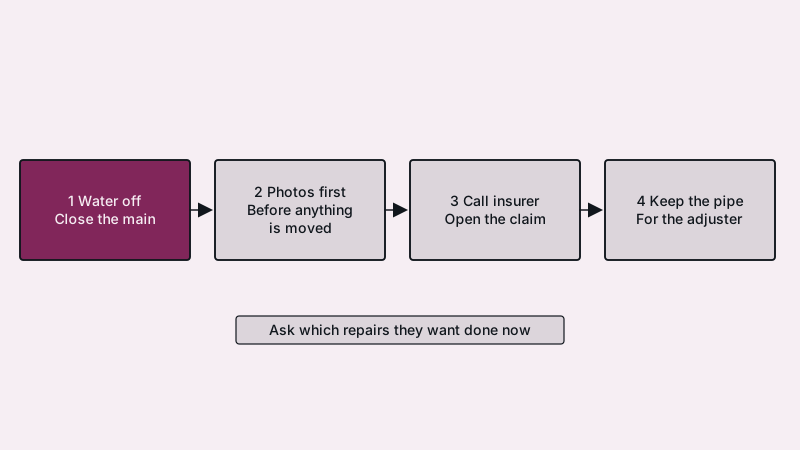
Then phone the insurer to open a claim and ask which emergency repairs they want done immediately. Keep damaged material until the adjuster has seen it. Warning signs are laid out under spotting a burst pipe, and a plumber can be arranged through emergency burst pipe service.
What should the plumber's invoice say?
It should name the failed part and where it sat, give the likely cause if known, and list the work done, the dates and the cost. Photos of the broken section add weight. Adjusters use this to decide whether the break was sudden, so vagueness hurts you.
Keep the cut-out pipe in a bag. The paperwork should also carry the contractor's name and state license number, since a license becomes mandatory once the job reaches $1,000. A repipe after a burst makes that relevant, and so does the cap on an up-front deposit, set at the lesser of 10 percent of the price and $1,000.
What if the insurer says no, or pays only part?
Ask for the decision in writing with the policy wording it relied on, and set that against your own copy and timeline. The state insurance department runs a Getting Help section for questions and complaints, a sensible next stop when a claim seems mishandled.
Before filing a small claim, weigh it. Wikipedia notes that claims can raise premiums or affect renewal. Some owners pay a minor repair and claim only large damage; your deductible is the number to compare.
Is it different for a rental or a condo?
Yes, because ownership of the pipe changes who claims. A renter's policy protects belongings and the landlord's protects the building. In a condo, an association policy covers some parts and yours covers others, and a pipe inside a wall can belong to either side.
Look at the association's documents to see where its coverage stops, and report any leak in writing right away.
Common questions
Is the pipe inside a wall covered?
Frequently the soaked drywall and flooring is paid for, while the work to open the wall and reach the pipe may or may not be. Forms differ on both. Stop the water, photograph everything, and ask the insurer about the access cost and the pipe repair separately.
What about a break caused by an earthquake?
Standard policies typically exclude earthquake, which is sold as its own coverage with its own deductible. If you carry that cover, check its terms against the policy before repairs begin. If you do not, expect the water damage to be your cost, though you should still ask.
Will filing push my premium up?
It can. Filing a claim may raise rates or affect renewal, as Wikipedia notes. People often compare the repair bill with the deductible first. Ask your agent how the company handles it, and do not sit on a large loss just to avoid a rate change.
How soon must I report a burst pipe?
Policies call for notice within a reasonable time, and some name specific deadlines. Report as soon as the water is stopped and the photos are saved. A late report makes the cause harder to prove and lets damage spread, which the insurer can hold against you.
For the wider picture, start with plumber mission viejo.
Sources
Updated