
Galvanized pipe is zinc-coated steel, and once the coating wears away the pipe rusts inward, narrowing the bore until pressure drops and water turns brown. It cannot be cleaned out for long. The fix is a whole-house repipe, normally in PEX or copper, under a permit with an inspection. The prices here are summaries of published guides, nothing firmer.
Is the pipe in my house galvanized steel?
Check the exposed runs: next to the tank, below sinks, along the garage wall, around the meter. Galvanized is dull gray with threaded joints, and a magnet clings to it. Copper looks orange-brown. PEX is red, blue or white plastic. Rust streaks at fittings and brown water from a cold start are the hints.
Try a scratch test somewhere out of sight, with a key. Silver-gray that attracts a magnet is galvanized steel; a coppery scratch is copper. Test several spots, because decades of repairs often mix materials.
Where is it likely here? Most of Mission Viejo was built from the 1960s onward, so tract homes more often have copper, and some have polybutylene from the late 1970s to mid 1990s. Galvanized is more plausible in pre-1960s houses in older parts of nearby San Juan Capistrano, San Clemente and Laguna Beach, in brief secondary runs, or wherever an old house got an addition. I would check rather than assume.
How can I tell old galvanized pipe is on its way out?
Watch for pressure that sinks over the years, worst upstairs; orange-brown water once the house has stood idle; tubs and washers that fill slowly; and weeping threaded joints. Rust narrows the pipe so a hot tap and a cold tap running together reveal weak flow. Cold water stays clear longer than hot, since heat speeds corrosion.
Rule out a supply problem first. A failing regulator at the meter lowers pressure on any pipe material, and the low water pressure guide separates the two. A low-cost pressure gauge on the front hose connection reads the supply; strong there but weak at the kitchen tap points at the house piping.
How much does galvanized pipe replacement cost?
Orange County guides for 2026 place a PEX whole-house repipe between about 4,000 and 18,000 dollars, with recent contractor pages bunching near 8,000 to 16,000. Copper runs higher, roughly 8,000 to 30,000 or more. Fixture count, slab or crawl-space access and wall patching steer the price. Read it all as a yardstick, never a quote.
Why such a spread? Repipe specialists quote low figures for simple single-story homes, and general contractors include more drywall and paint. A second bathroom adds a few thousand dollars at most, according to one Orange County guide. Ask whether patching and texture are included, since that can be a separate trade. Line items sit in the PEX repipe cost page, next to the repipe house cost guide.
If the damage is a single section, a partial replacement can make sense. Joining galvanized straight to copper invites galvanic corrosion, so a plumber uses a dielectric fitting or replaces back to a convenient break. Replacing everything at once is usually cheaper per foot than doing it in stages.
Does swapping out my house's pipes need a permit?
Yes, expect one. Contractor sources around the state treat a plumbing permit as routine for a whole-house repipe, with a rough-in inspection before the walls close, and the job is for someone holding the right state license. The permit is normally applied for by the plumber. Ask the city's Building Services Division what applies at your address.
A finished permit also helps at resale, since buyers and insurers like a repipe with an inspection on record. Treat an offer to skip it as a warning. Search the contractor in the CSLB database, and remember the deposit ceiling, a thousand dollars or ten percent of the job, whichever is smaller. Steps are laid out in how a repipe is done.
How disruptive is a repipe, and for how long?
Published California timelines put the pipe work at about two to five days for most homes, with a day or two more for drywall patching and the final inspection, so about a week from start to finish once the permit is issued. Permit lead time is extra and varies by city. Two-story slab homes take longest.
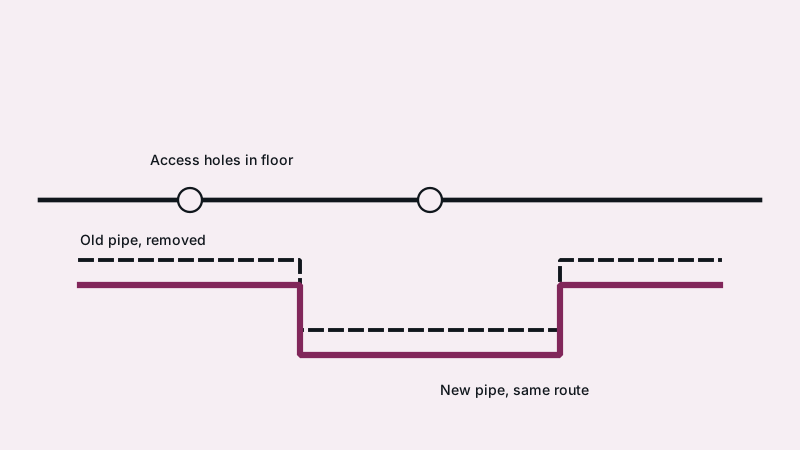
The taps go dry for part of every work day, and plumbers often turn it back on by evening. Expect cut openings in walls and ceilings, dust and noise. Ask what will be patched, what will be textured, and what is left for a painter. Clearing closets and moving furniture ahead of time speeds the job.
Does any program still pay to replace polybutylene?
Not at present, as far as the public record shows. A national settlement, known as Cox v. Shell, funded polybutylene replacement for eligible homeowners, but its claims period closed years ago, and a later class action was dismissed. Homeowners with polybutylene now pay for replacement themselves, though homeowners insurance may sometimes weigh in on water damage.
Gray plastic pipe dating from the late 1970s to the mid 1990s gets its own write-up at the polybutylene replacement page, including how to recognize it. The choice of new pipe is broken down in PEX versus copper, and why repipe a house at all covers the decision.
Common questions
Can galvanized pipe stay if the water looks clear?
Sometimes, for a while. Clear water and steady pressure suggest the interior is still open. Corrosion keeps advancing unseen, though, and a leak behind drywall is costly. If the pipe is more than 50 years old, ask for an inspection and a pressure test, and plan a budget rather than waiting for failure.
Is PEX or copper better as a replacement?
The California plumbing code accepts both. PEX is cheaper and quicker, bends around corners, and tolerates freezing better, which matters little in Orange County. Copper lasts for decades and is preferred by some owners, but hard water and certain water chemistry can cause pinholes. Compare in the PEX versus copper guide.
Does replacing galvanized pipe fix low pressure?
Usually yes, if the pipe was the choke point, since new pipe restores the full bore. If the main supply or the pressure regulator is the issue, new pipe will not help. To tell the two apart, a plumber compares pressure at the spigot with pressure at the fixtures.
Can I replace it myself?
Homeowners may do some work themselves, yet a repipe brings permits, inspections, heater connections and pressure testing, and one bad joint floods a wall. Most hire out the whole-house job and keep simple fixture swaps. Ask the city before starting.
Will new pipes change my water taste or hardness?
New pipe removes rust and the metallic taste it causes, but it does not soften the water. New pipe does not soften anything. Moulton Niguel Water District has listed hardness of 13 to 17 grains per gallon in several recent years (confirm which district serves your street), which keeps scaling fixtures. A softener treats that separately.
This guide is one of many on plumber across Mission Viejo.
Sources
- Published 2026 Orange County and California repipe price guides, compared
- Published California whole-house repipe timelines and permit practice, compared
- SEC filings on the Cox v. Shell polybutylene settlement (Celanese 10-Q, 2010)
- City of Mission Viejo, Building Services Division
- CSLB, hiring a contractor
Updated