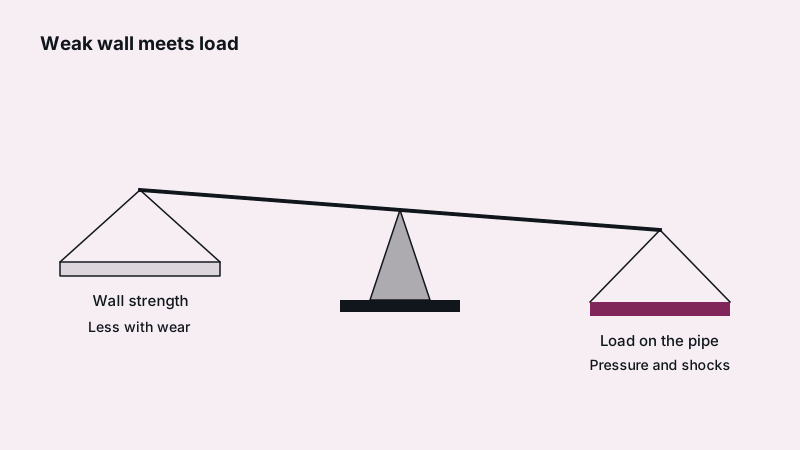
A pipe bursts the moment the load inside it exceeds what the wall or its joints can carry. Ice is one source of that force, and the best known, but in Mission Viejo the usual suspects are line pressure that runs too high, copper worn thin from the inside, a joint that was never seated properly, and sudden pressure spikes from water hammer. This page works through them, and the leaks page shows what to do once water is already out.
Is water spraying right now? Head straight to emergency help for a burst pipe.
Why does a pipe burst at all?
A burst needs a weak spot and a load. Water cannot be compressed, so when pressure rises, or trapped water expands, it pushes on every inch of the pipe wall at once. Pipe that is thinned, cracked, corroded, kinked or badly joined gives way first. The failure is sudden only in appearance; the weakness was usually there for months.
Think of it as a sum: wall strength minus wear on one side, pressure plus shocks plus temperature swings on the other. Anything that shrinks the first or grows the second brings the break closer.
Does freezing really burst pipes in a place like Mission Viejo?
It can, but it is rare here. Water swells as it freezes, and the pressure trapped between an ice plug and a shut faucet is what splits the pipe. Orange County sees few hard freezes, so exposed pipe on a north wall, in an attic or in an unheated garage during a rare cold snap is the realistic risk.
Insulating exposed pipe and hose bibs costs little. What to wrap, and when to leave a faucet trickling, is spelled out under burst pipe prevention. A home that sat empty during cold weather is more at risk than an occupied, heated one.
Can warm weather burst a pipe?
Heat alone does not burst a healthy pipe. Summer bursts trace back to pressure: sprinkler valves that snap shut, and thermal expansion in a hot-water system with nowhere to relieve it. Tired copper and fittings stressed all year can give out in any season, and warm months have no special immunity.
Two practical notes. First, a gauge screwed on a hose connection outside reads your static pressure in about a minute. Many plumbing codes call for a regulator above roughly 80 psi, a figure to confirm with the City of Mission Viejo Building Division. Second, a water heater on a closed system needs room for expansion, usually an expansion tank, or pressure climbs every time the burner fires. See the pressure regulator guide.
Which problems in older Mission Viejo plumbing lead to a burst?
Four recur in houses built between the seventies and nineties: high pressure from hillside supply zones, pinhole corrosion in copper, polybutylene pipe with plastic or metal fittings, and galvanized steel that has rusted narrow from inside. A fifth, ground movement, can twist a buried line or a pipe under a slab.
- High pressure. Homes below a reservoir or at the bottom of a slope can see more pressure at the tap than the pipes were rated for in practice. Regulators fail and nobody notices.
- Pinholes in copper. The pipe seeps before it bursts, so you see green crust or damp drywall first. See copper pinhole leaks.
- Polybutylene. Gray or blue flexible pipe went into many homes from about 1978 until the mid-1990s and is known for failures at its fittings. See polybutylene replacement.
- Galvanized steel. Rare in newer tracts, common in the oldest ones, narrowing inside until pressure behind the blockage rises.
- Slab and buried lines. Movement and abrasion against concrete or rock can wear through a pipe. The slab question is covered at slab leak repair or repipe.
How can I recognize a burst or about-to-burst pipe?
The signs come in two stages. Early on, you may see a ceiling stain, a bulge in drywall, damp or musty smell, a hiss with taps off, or a water meter that moves when nobody is using water. When a pipe has actually burst, expect a sudden loss of pressure, noise like running water in a wall, and water appearing at floors or ceilings.
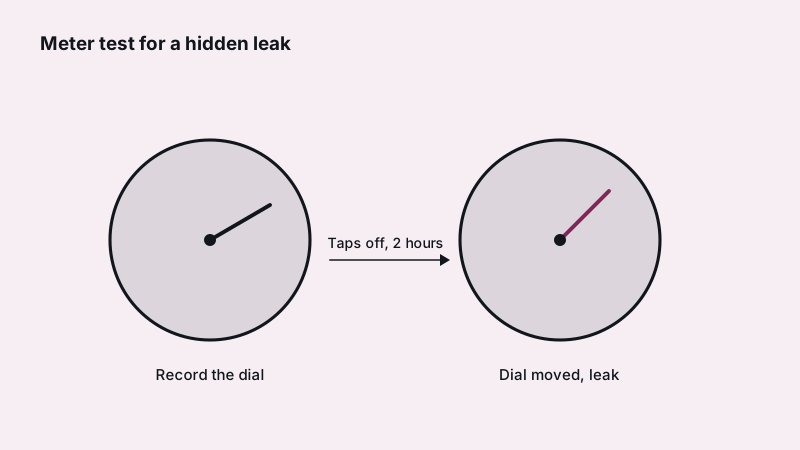
The quiet kind shows on the meter: record the dial, leave the taps alone for a couple of hours, then compare; any movement is a leak. A longer checklist lives in telling whether a pipe has burst, and ceilings get their own page, signs of a leak in the ceiling.
When a leak shows up inside a wall, leak detection with a listening device or a thermal camera finds the break before any drywall is cut. How detection is priced is covered under leak detection cost.
What are the first moves after a burst?
Shut the main valve, empty the line at a low tap, cut power to anything soaked if you can get there safely, and call a plumber. Then photograph the damage and notify your insurer. Never wait to see whether it stops; at household pressure a burst can pour out a surprising volume within minutes.
First-hour steps are in the emergency plumbing guide. On who pays, see burst pipe insurance: policies often pay for resulting damage while treating the pipe repair differently.
How do I lower the chance that a pipe will burst?
Four habits do most of the work: check that pressure sits in a sane range, fit an expansion tank where the hot-water system is closed, wrap exposed pipe, and renew aging fittings and flex lines early. Replace whatever is visibly worn, and exercise the main shut-off each year.
Pipes failing in several places may be better served by a full repipe than by repeated patches. Exposed lines in the garage and attic tell a plumber a lot about which of these causes applies to you.
Common questions
How does a winter freeze split a pipe?
Ice forms, blocks the pipe, and the pressure building against a closed tap splits the wall, normally at a weak spot. The leak often shows only after the thaw. In Mission Viejo that is uncommon, but a severe cold snap can still catch exposed pipes.
Can a pipe burst from high water pressure alone?
Yes, when a pipe or fitting is already weak. Steady high pressure shortens the life of fittings, valves, braided hoses and the heater, and water hammer adds sharp shocks. A cheap gauge on an outside spigot gives the number, and a regulator is the usual cure for a high one.
Can a burst pipe happen inside a wall without me knowing?
Yes. Small failures can run for weeks, showing up only as soft drywall, a musty odor or a creeping bill. Typical household leakage tops 9,300 gallons yearly, by the EPA's count. Try the meter test and book detection instead of cutting walls open blindly.
How long until a burst pipe is fixed?
Pipe you can reach is fixed quickly. A break behind finished walls or beneath a slab drags on longer, followed by drywall, paint or flooring work. Ask the plumber for a rough duration along with the quote, and remember that drying out the damage is a separate step.
Do burst pipes always mean the whole house needs repiping?
No. One failure in otherwise sound pipe is often repaired alone. Several failures, pinholes in many spots or polybutylene point toward a repipe. Have the exposed pipe inspected first, and get both options priced on paper before you decide, so the choice rests on what the plumber actually saw.
This guide is one of many on plumber in Mission Viejo.
Sources
Updated