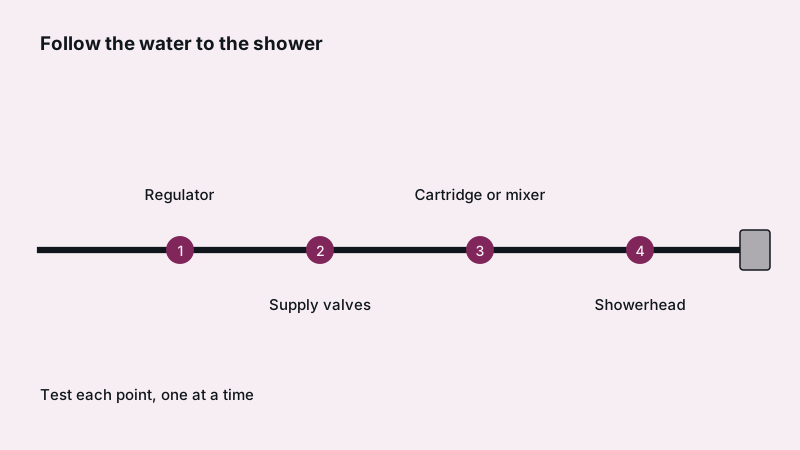
A weak shower is nearly always a local problem: a scaled showerhead, a worn cartridge, a half-closed stop or a mixing valve out of order. The whole house being weak is rarer, and it needs a different diagnosis. Try the showerhead first, since it costs the least. Other fixture work, such as under-sink and disposal plumbing, sits with garbage disposal repair and kitchen-side fixtures, and a plumber for any of it comes through the quote request.
Is it the showerhead or the whole house?
Try this quick comparison: the tub spout, the bathroom sink and an outdoor spigot, one after another. Strong everywhere except the shower puts the blame on the shower. Weak everywhere moves it upstream, to the main, a regulator or a leak. That single test removes most of the guessing.
Then compare hot with cold. Strong cold and feeble hot sends you toward the water heater side: a half-closed valve, sediment, a tired heater. The whole-house version is unpacked in what makes pressure drop at home, and the hot-only version in low hot water pressure.
Can a clogged showerhead cause weak flow?
It can, and it tops the list around here. Hard water leaves white or greenish crust in the spray holes. Unscrew the head, let it sit in a bowl of white vinegar through a long coffee break, rub the nozzles with a soft brush, rinse, and refit it.
Add fresh thread tape on the way back on. If a flexible hose joins arm and head, check it for kinks and scale as well. Better flow means you found it. A head that is old and rusty can simply be replaced. For stubborn crust and what causes it, see removing hard water scale.
Why does a new showerhead feel weaker than my old one?
Flow limits. WaterSense showerheads are capped at 2.0 gallons per minute, while many older heads delivered 2.5 or more, and California's appliance rules also limit new heads. A restrictor disc inside reduces flow by design, so a new head can feel gentler even when pressure is fine.
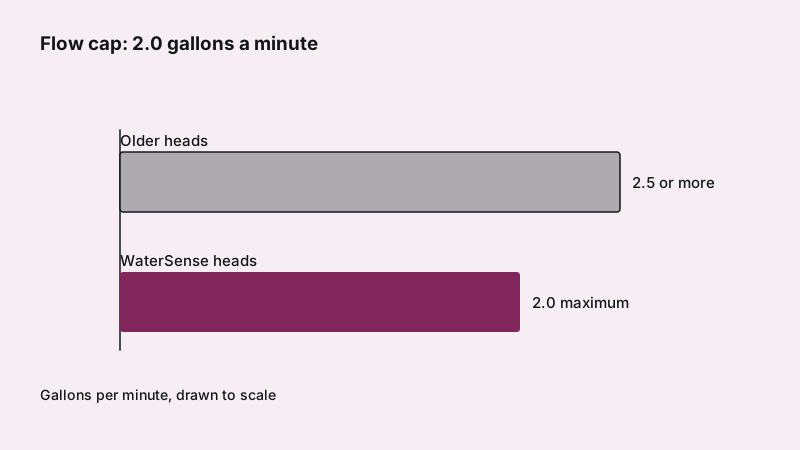
EPA says WaterSense models are tested for pressure compensation, meaning they keep a minimum flow across a range of household pressures. Shop for one rated for low pressure, and do not drill out or remove a restrictor expecting a miracle, since the household pressure still limits the result. Spray pattern changes the feel more than people expect: a wide rain pattern feels softer than a narrow jet.
What if the shower valve or cartridge is the problem?
A worn or clogged cartridge in a single-handle valve, or a failing mixing valve, restricts flow behind the wall. Sediment from a recent repair can lodge in it too. Signs: the pressure dropped on one side, temperature swings, or the handle is stiff and gritty.
A cartridge swap is moderately easy: water off, handle and trim removed, old cartridge pulled, identical model pushed in. If you cannot match the part or reach the valve, hand it to a plumber. Drips from the same valve are a related repair, taken up in shower faucet leaks. A diverter that no longer seals fully can send water to the tub spout and weaken the shower.
Could the supply valves or pipes be partly closed or clogged?
Sometimes. A valve behind the access panel or near the heater can be left half shut after a past repair, so confirm that each valve on the line is fully open. Old galvanized or corroded pipe can narrow inside, which reduces flow gradually and starts at the farthest fixtures.
A second-floor shower in a house with aging pipe is the classic victim, since it has the least pressure to spare. Water heater sediment can also choke hot-side flow. If pipes are the cause, repair is a larger job, and a gauge reading helps the plumber decide. See low water pressure service for the diagnosis.
What will it cost to get decent shower flow back?
Cleaning or replacing a showerhead is the cheapest fix, a plumber swapping a cartridge costs more, a whole valve costs more again, and pipe or regulator work is the largest job. The written quote sets the real amount, so ask for each line item and what is included before work starts. That order also tells you where to stop spending.
If the whole house is weak, regulators come into it, and regulator replacement explains the job. A leak can also sap pressure, and EPA's average of 9,300-plus gallons lost per home each year is a reminder to read the meter before spending money.
Which quick checks are worth ten minutes before I call anyone?
Three. Take the head off and look at the screen and nozzles. Flip the shower on with the head removed to see the raw flow from the arm. Then confirm the stop valves are fully open, which takes a screwdriver at most. Together they sort head problems from valve problems from supply problems.
If you rent, tell the landlord what you found instead of opening walls or valves behind panels. If you own, write down what each test showed, since a plumber can use those notes to go straight to the likely cause. It also helps to note whether the weak flow arrived suddenly or crept in over months, because sudden changes point to a stuck valve and slow ones to scale.
Common questions
Why does pressure sag at certain hours?
When many neighbors draw water at once, pressure can dip, most noticeably on the far end of a district's line. If it bounces back by mid-morning, nothing inside your house is wrong. Always weak? Thread a gauge onto a spigot and read it at several times of day.
Should I take the flow restrictor out?
It rarely helps much. The disc caps flow and does not set household pressure, so removing it adds a little volume, wastes water and may void a product's rating. A head engineered for low pressure, plus descaling, is the better route.
Is the shower arm itself the problem?
Remove the head and let the arm run into a bucket for a few seconds. A strong, clean stream clears the arm and blames the head. A thin or sputtering stream means the trouble sits in the arm, the valve or the supply, and more checks follow.
At what stage should I hand it to a plumber?
Once the head is clean and flow is still weak, a new cartridge changed nothing, other fixtures are weak as well, or the house has galvanized pipe. The plumber measures pressure, checks valves and inspects the cartridge, and usually reaches an answer in a single visit, so you are not paying for guesses.
For the wider picture, start with plumber in Mission Viejo.
Sources
Updated