Silence from a tankless gas heater normally comes with a clue on its display. Error codes, a burner that keeps dropping out, scale on the heat exchanger, or a flow sensor that has stopped noticing water explain most of it. A few checks are yours to make: power, the gas valve, the water valves and the inlet filter. Anything touching the burner or gas pipe goes to a plumber. Wider options sit on the water heater page.
Why does a tankless unit refuse to ignite?
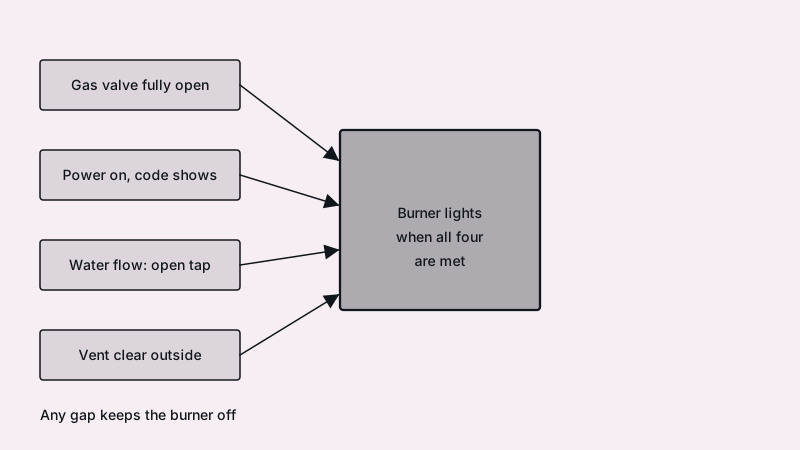
It lights only with enough flow, gas, power and a clear vent, and a gap in any of them keeps the burner off. Typical causes: a partly shut gas or water valve, a tripped breaker, a clogged inlet screen, a dirty flame sensor, a scaled-up heat exchanger, or a blocked vent.
Walk through them in this order, safest first:
- Confirm the display has power and shows a code.
- Check that the gas shutoff and both water valves are fully open.
- Open a tap all the way, since many units refuse to light on a trickle.
- Look for a blocked vent terminal outside, such as a nest, leaves or a cover.
- Copy down the code and find it in the manual.
A smell of gas near the unit means everyone leaves at once; SoCalGas, reachable at 1-800-427-2200 after you are outside, deals with gas leaks, and 911 deals with injuries.
What do tankless error codes mean?
Each maker uses its own codes, and the manual or the maker's support line gives the true meaning. In general terms, codes cluster around ignition failure, flame loss, overheating, flow or sensor faults, exhaust or vent problems, and condensate or water leaks. A code is a clue, not a diagnosis. Write it down and keep the model number handy.
Resetting by cutting power for a minute sometimes clears a one-off glitch. A code that keeps coming back points to a cause still present. Do not keep resetting a unit that trips an overheat or vent code, since the safety systems are doing their job.
What makes the water lukewarm, or swing between hot and cold?
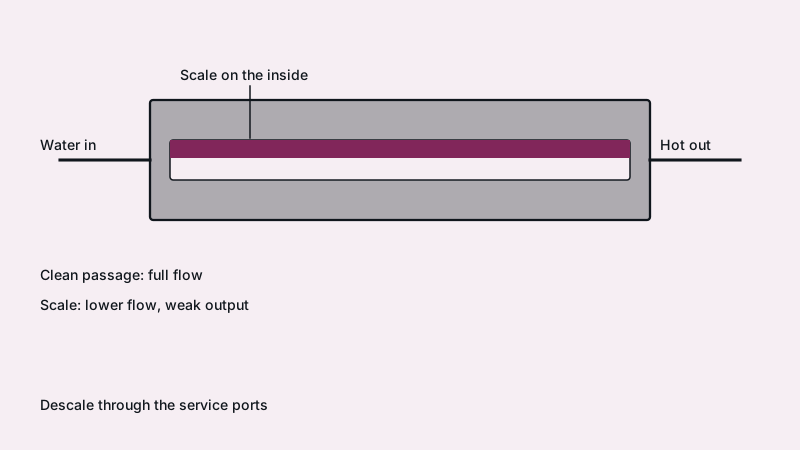
Lukewarm output often comes from scale narrowing the heat exchanger, a partly blocked inlet filter, or a flow so low that the unit cannot hold temperature. The cold-water sandwich, a short burst of cold between hot slugs, comes from the pipes holding cooled water. Running several fixtures at once can also exceed what the unit can raise.
Hard water is the common cause of scale, and most manufacturers ask for periodic descaling, a vinegar or manufacturer-approved flush through the heat exchanger done with service ports. Your water district publishes hardness figures for hardness figures, and see the page on tankless installation for what a unit needs at install, including isolation valves that make flushing possible.
Which parts fail most on a gas tankless heater?
Flame rods and igniters foul or wear, flow sensors clog, thermistors drift, the exhaust fan motor or pressure switch fails, condensate traps clog on condensing models, and scale chokes the heat exchanger. Each can be tested by a plumber, although some parts come only through the manufacturer.
Whether repair makes sense depends on the unit's age and price of the part. A cracked heat exchanger in an aging unit often points toward a new one. The page on tankless repair cost explains how that call is usually made.
Is the problem the vent, gas supply or the unit itself?
Venting and gas supply both matter. Many gas tankless models draw more gas than the tank they replaced, so an undersized line shows up as a unit that lights then drops out under heavy use. A damaged or mismatched vent causes exhaust faults. These are regulated tasks: gas piping and venting are contractor work, and the city's Building Services Division reviews permits.
The City of Mission Viejo's handout on water heaters sets general rules for gas heaters, such as a sediment trap and a listed flex connector on the gas line, and an expansion tank when the supply is a closed system, which a recirculation or backflow setup can create. The contact is 949-470-3054.
Can I fix a tankless water heater myself?
Reset, replace a clean inlet filter screen, flush for scale if isolation valves exist, and clear an obvious outdoor vent obstruction. Stop there. Burner, gas valve, gas pipe, venting and electrical repairs belong to a contractor, and from $1,000 up, California treats the work as contractor-license territory. Gas work also needs proper gauges for combustion and leak testing.
Never bypass a safety switch, run the unit with the cover off, or ignore a carbon monoxide alarm. A carbon monoxide alarm near gas appliances costs little and helps a great deal.
When is replacing a tankless heater better than repairing it?
Replace rather than repair when the heat exchanger is gone, parts cannot be found, repairs keep recurring, or years of hard water went by without descaling. A newer model may also fit your household better. Replacement has its own scope, covered in gas tankless installation and weighed in tank versus tankless.
A price request with the make, model and error code lets us line up a plumber nearby, and the figure comes to you on paper.
Common questions
How often should a tankless heater be flushed?
Many makers suggest yearly, and in hard water more often. The flush circulates descaler through the exchanger for a set time and then rinses. It needs isolation valves with service ports. A plumber can do it in a visit, and your manual states the maker's interval and approved solutions.
Why does my tankless heater say no flow?
The sensor does not detect enough water. Causes include a closed valve, a clogged inlet screen, low supply pressure, a faucet aerator clogged with scale, or a failed sensor. Open a tap fully and try again. If the code remains after cleaning the screen, the flow sensor or a restriction in the line needs a plumber.
Is a tankless heater covered by warranty for scale damage?
Often not. Many warranties exclude damage from hard water or from skipped maintenance, so check your terms. Keep records of flushes and service, since they matter if you need to make a claim. Warranty terms differ by model, and the manual lists conditions and exclusions.
How long does a repair take?
Simple fixes, such as cleaning a filter or replacing a sensor, usually take a short visit. A part that must be ordered adds days. Heat exchanger replacement is longer. The plumber should explain which case you have after testing, and quote before work.
The rest of our guides start from plumber in Mission Viejo.
Sources
Updated