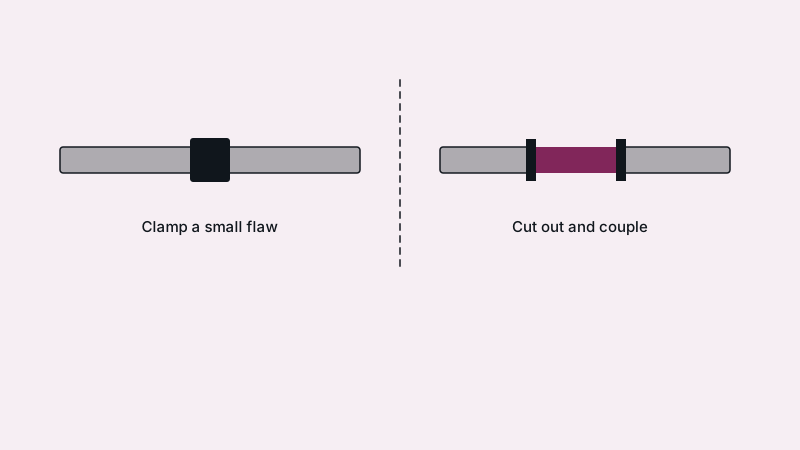
Two repairs cover nearly every leaking supply pipe: cut the damaged stretch out and join new pipe in its place, or wrap a small flaw with a clamp or coupling. The material picks the method, because copper pinholes, PEX splits and polybutylene fittings all fail in their own way. Budget about $200 to $2,500, mostly set by whether the pipe is in plain view. To arrange a visit, use the quote request; active bursts fall under leak and burst pipe service.
Is that pipe leaking, or only sweating?
Let the water meter decide. Turn everything off, jot down the dial reading, and come back to it after two hours. Movement means water is going somewhere. Cold pipes in humid weather bead and drip harmlessly, so the meter test comes before anyone opens a wall.
Real leaks announce themselves in other ways: a hiss in a silent house, damp drywall or flooring, a slab that feels warm underfoot, a bill creeping up, soft pressure. EPA puts typical household leak losses at over 9,300 gallons annually, and a wall leak nobody sees is one way to reach that. Finding the spot without demolition is the subject of leak detection cost.
What can I do before the plumber shows up?
Find the closest valve for that branch (or use the main), then open the bottom-most faucet to drain the pipes. A rubber patch under a hose clamp or a repair sleeve, set on an exposed straight run, holds a few hours. Epoxy putty can plug a pinhole in dry copper.
Nothing here is permanent, and none of it suits a joint hidden inside a wall. If water reaches outlets, cut that breaker from dry footing. Photograph everything for the claim file, since state insurance guidance stresses limiting further damage, keeping receipts and reporting promptly. Leave the leak uncovered and unpainted so the plumber sees it.
What happens when copper pipe starts to leak?
For a pinhole, the plumber cuts out a short length and replaces it with a new piece joined by soldered fittings or push-fit couplings. Repeated pinholes along a run mean the pipe is thinning internally, and patching hole after hole only buys time. Then a repipe starts to cost less than repeated visits.
Copper in many 1970s and later homes here is original, now three to five decades old. Hard water, high velocity and aggressive water chemistry can all pit the inside. A single pinhole in a younger house is a repair, while several in one year is a pattern. Techniques and photos are in repairing a pinhole in copper pipe and copper pipe pinhole leaks.
Do PEX, polybutylene, galvanized and plastic pipes need different repairs?
They do. PEX takes crimp or expansion couplings and forgives a single leak. Polybutylene, the gray plastic piped into some tracts between the late 1970s and the mid 1990s, tends to give way at its fittings, and many plumbers advise replacing it. Galvanized steel corrodes inward, which means one leak suggests the rest is close behind.
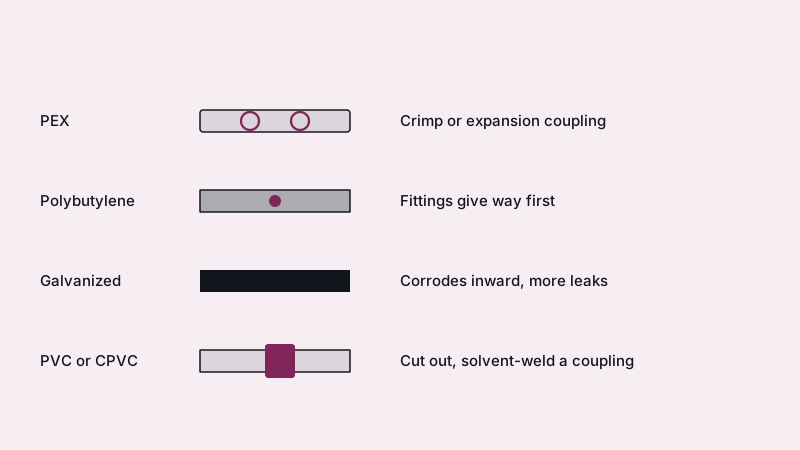
PVC and CPVC are mended by cutting out the damaged piece and solvent-welding in a coupling. Plastic irrigation or drain lines make the easiest case, and leaks in plastic pipe covers it. For materials and comparisons, read PEX versus copper, polybutylene replacement and galvanized pipe replacement.
Will the wall or the slab have to come open?
Inside a wall, a plumber cuts a neat window at the damp spot, mends the pipe and hands patching to a drywall trade. Beneath a slab, electronic listening and pressure tests pinpoint the leak before anything is broken. Then the choice is a dig, or a new route overhead.
The line's leak history and its route tilt that decision. A lone reachable leak gets a spot repair, while repeat leaks or a failing material argue for a new run. Slab leaks: repair or repipe works through the trade. Ceiling stains mislead, since water travels along framing away from the break.
How much should a pipe leak repair set me back?
Rough national bands from Fixr: $150 to $500 for a kitchen break or an in-wall pipe fix, $150 to $800 for a bathroom one, and $1,000 to $4,000 when the slab is involved, with drywall repair of $75 to $700 on top. Material, access and finishing all push the figure around, and the written quote issued after the plumber sees the break is the one to rely on.
Fixr puts plumber rates at $45 to $200 an hour nationally. Wall patching and paint usually bill separately, and so does drying out after a burst, which an insurer may or may not cover. On the paperwork side, a state contractor license is expected from $1,000 of work, and a deposit may run no higher than a tenth of the price, or $1,000 if that is smaller.
Common questions
Do epoxy, tape or a clamp work as repairs?
As stopgaps on an exposed pipe with a pinhole or small split, yes, and a gasketed clamp or sleeve is the most reliable. They are not lasting repairs for a joint, a seam split or anything behind a wall. Think of them as borrowed time.
Spot repair or a whole new line: how do I decide?
Count the leaks and note the material. One leak in sound pipe is a spot repair. Several in a year, or polybutylene, thin copper or galvanized steel, favor replacing that run or the whole system. The plumber can price both routes in one visit.
Does a leak in the wall need a same-day call?
It needs fast action, since wet framing rots and feeds mold. Shut off that line or the main and phone. A slow leak on an isolated line can wait for a next-day visit. Spraying water, a sagging ceiling or contact with electrical parts cannot.
Will my insurer pay for the pipe repair?
A typical policy responds to water damage after a sudden release, and often excludes the pipe itself and any long-running leak. Report early, photograph the damage and keep receipts. Your own policy wording governs, so call the agent before big repairs begin; burst pipe coverage has more.
This guide is one of many on plumber across Mission Viejo.
Sources
- Fixr, Burst Pipe Repair Cost
- Fixr, Slab Leak Repair Cost
- Fixr, Cost to Hire a Plumber
- EPA WaterSense, Fix a Leak Week
- California Department of Insurance, Residential Property Claims Guide
- Wikipedia, Plumbing
- Wikipedia, Water hammer
- CSLB, hire a contractor
- Published plumbing repair price guides, checked November 2026
Updated