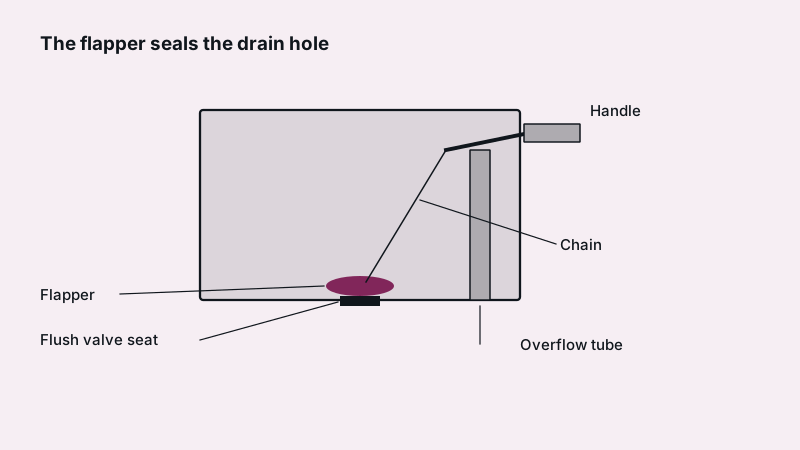
Think of the flapper as a rubber stopper on a hinge. A flush lifts it, the tank drains, and gravity drops it back over the hole. After a few years the rubber stiffens or gets gritty, the seal fails, and the tank leaks into the bowl a little at a time until the fill valve kicks in to refill it. That faint refill sound at odd hours is the flapper talking. Other tank and base faults are handled in the toilet repair overview; this page stays with the flapper only.
Have the replacement part, a rag and perhaps pliers within reach. That is the whole kit.
What proves that the flapper is the culprit?
Dye settles the question. Squeeze some food coloring into the tank, nobody flushes, and ten minutes later you peek into the bowl. Coloured bowl water means the flapper is leaking. Other clues: the toilet refills at odd moments, a faint hiss lingers after a flush, or the handle feels slack.
The EPA's advice on flappers is a periodic check and a replacement no later than every five years. A stiff flapper is among the cheapest household leaks to stop, so the job is worth doing.
Eliminate the other suspect while the lid is off. Water creeping over the overflow tube points at the fill valve instead, covered in replacing a fill valve.
Which replacement flapper fits my toilet?
Match two things: the diameter of the drain hole and the way the old part attaches. Round flappers of two or three inches are the norm, while canister and dual-flush designs use a different seal. The easy route is to carry the worn flapper to the hardware store, or to read the model code molded into the tank and search with it.
Quick identification:
- Hole size. Measure the opening the flapper covers. Many older tanks have two inches; many newer, water-saving ones have three.
- Mounting style. Side ears that hook onto pegs on the standpipe, or a ring that slips around it.
- Unusual flush mechanisms. A tall canister or twin buttons on top mean a plain flapper will not do.
- Brand parts. Makers such as Kohler and Glacier Bay sell shapes of their own, so model number beats guesswork.
Adjustable universal flappers suit a lot of toilets, though a part made for your model seals most reliably.
How do I put a new flapper in?
Start at the stop valve behind the bowl and turn it off, then flush until the tank is nearly empty. Now detach the chain, ease the old flapper's ears off their pegs, and snap the new one on so its rubber lip lies flat across the opening. Reattach the chain with slack, reopen the supply, let the tank refill, and flush twice while watching for leaks.
Do these small things too:
- Wipe the ring the flapper sits on with a wet rag. Grit on that seat leaks even with a brand-new flapper.
- Leave roughly a finger's width of loose chain once the flapper is down.
- Snip or tuck extra chain so a loop cannot slip under the rubber.
- Run the dye test again after about an hour.
Why does the toilet still run after I fitted a new flapper?
Usually the seat is rough or scaled, the chain is too short, the part is the wrong size, or the overflow tube has a crack. Seats are the most overlooked: rub the ring gently with a non-metal scouring pad. A pitted seat needs a flush valve repair or a new one, which is plumber territory.
Mineral buildup matters. The USGS puts the start of very hard water at more than 180 mg/L, and deposits collect on seats and rubber. If flappers keep failing early, see hard water scale prevention. Rubber also ages whatever the water, so a stiff, sticky or swollen flapper should simply be replaced.
If nothing here fits, the cause may lie elsewhere in the tank; why a toilet keeps running lists the other culprits.
How should the flapper chain be set?
Aim for a little slack when the flapper sits closed, and enough pull to raise it fully when the lever goes down. Clip it into the lever-arm hole that gives that slack. A chain that snags under the flapper needs shortening, and a worn chain is replaceable. Many flappers come with a chain attached.
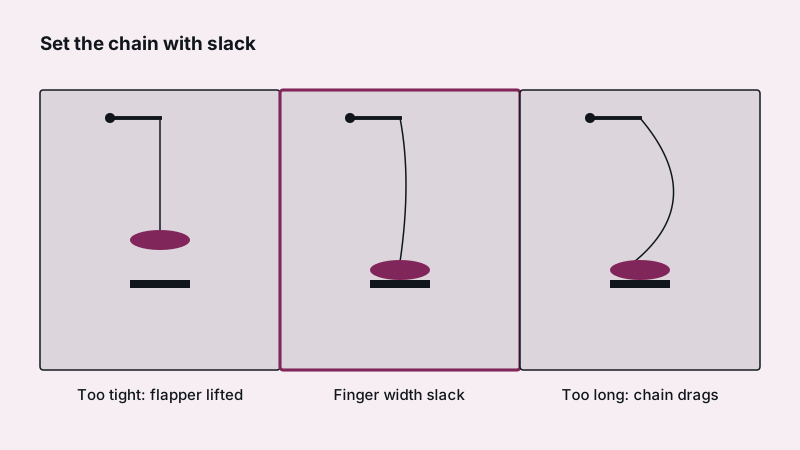
A tight chain keeps the flapper off its seat; a loose one forces you to hold the handle down. Shift the chain a link at a time and test again. If the lever has snapped or the handle is loose, toilet flush repair covers that.
When does a flapper job turn into a plumber's job?
Call a plumber when the seat is damaged, the standpipe is cracked, water leaks at the tank bolts or around the base, or a fresh flapper changes nothing. Each of those means unbolting the tank or lifting the toilet, and a plumber can weigh whether a new toilet beats another round of parts.
For those routes, read toilet leak repair and replacement cost. To book a visit, send the request form; other jobs we arrange are listed from the home page.
Common questions
What is the replacement interval for a flapper?
The EPA says to replace one at least every five years. Some go longer and some fail sooner, depending on water quality and what has been dropped in the tank. A toilet that starts refilling on its own is the usual first warning.
Does a universal flapper work?
Often, yes. Adjustable versions fit many two-inch and three-inch toilets, though a part made for your model number seals best and a few toilets demand a specific shape. If a universal one leaks, switch to the manufacturer's part, and keep the old flapper and your toilet's model number handy when shopping.
Can tank cleaning tablets ruin a flapper?
They may. Some tablets and bleach products sit in the tank and can degrade rubber over time. We could not verify a claim about any named brand, so the cautious move is to skip in-tank cleaners and clean the bowl instead. Replace a flapper that looks swollen or tacky.
Why does my toilet refill every few minutes by itself?
Tank water seeps into the bowl past a tired flapper, and the fill valve then refills the tank. Repeating on a timer, that cycle is what a failing seal looks like. Dye test, wipe the seat, check the chain, and replace the flapper if it still leaks.
Should a plumber replace a flapper?
Usually not, since it is one of the gentler plumbing jobs. A plumber is worth booking if the seat is damaged, you cannot match the part, or the toilet leaks somewhere else too. While there, the plumber can look over the rest of the fixture.
Sources
Updated