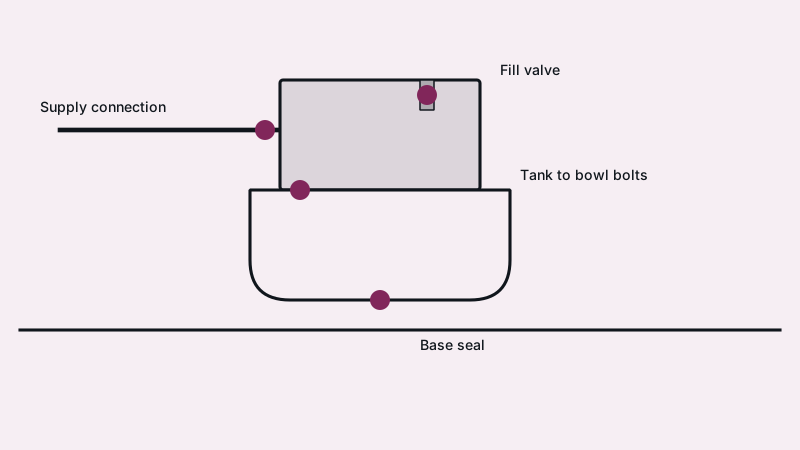
Grab a dry towel and wipe the whole toilet, then wait for the first droplet to return. That droplet is your diagnosis. Wetness on the floor beside the porcelain base means the wax seal or the floor bolts. A bead hanging from a bolt under the tank means a worn washer. A wet fitting at the wall means the supply connection. And if nothing drips yet the tank keeps refilling on its own, the trouble is inside, at the flapper. Most of these are home jobs. For the rest, our toilet repair page explains how a plumber gets arranged, or send the quote form.
Which part is leaking, judging by where the water shows?
Pair the wet spot with a part. Floor puddle: wax ring or closet bolts. Water on the underside of the tank: tank bolts or their rubber washers. Wet joint where tank meets bowl: the tank-to-bowl gasket. A wet wall connection: braided line or the valve's packing. Nothing visible: flapper or fill valve.
| First wet spot | Suspect | Skill needed |
|---|---|---|
| Floor around the base | Wax ring, loose bolts | Some muscle |
| Bolt heads beneath the tank | Rubber washers | Beginner |
| Seam between tank and bowl | Gasket | Intermediate |
| Wall valve, hose connection | Supply line, packing nut | Beginner |
| Entire tank exterior in humid weather | Condensation | None |
| Tank refills with no drip | Flapper, fill valve | Beginner |
How can I catch a leak that leaves no puddle?
Dye gives the answer. Add a squirt of dye to the tank, keep your hand off the handle, and look in the bowl ten minutes on. Dye showing in the bowl means the flapper leaks. According to EPA, tired flappers account for most toilet leaks, and leaks of every kind cost the typical house over 9,300 gallons yearly.
The silent leak is the expensive one, because it never leaves a mark except on the water bill. Check the flapper's seat for slime or mineral crust, which stops a clean seal. How to replace it is in toilet flapper repair, and a related symptom, endless running, is in why a toilet keeps running.
What do I do about water pooling around the base?
Snug the floor bolts first, alternating sides in small turns. Porcelain breaks when it is overtightened, so stop at firm. If the pooling continues, the wax ring has lost its seal and the bowl must be lifted off its flange.
Close the supply, flush once, and soak up what remains with a sponge. Undo the supply line and the nuts, then lift the bowl straight up with a helper, because a toilet is heavy and slippery. Set it on towels, scrape the old wax from the flange, and check that the flange is firmly screwed down and flush with the flooring. Press a new wax ring and fresh bolts into place, lower the bowl squarely, and tighten gradually. Reconnect, refill and watch for a day.
Why is water dripping from beneath the tank?
Two bolts clamp the tank to the bowl, each with a rubber washer, and a gasket sits between the two pieces of porcelain. Washers harden with age, and mineral crust can corrode the bolts. One of those three is the usual source.
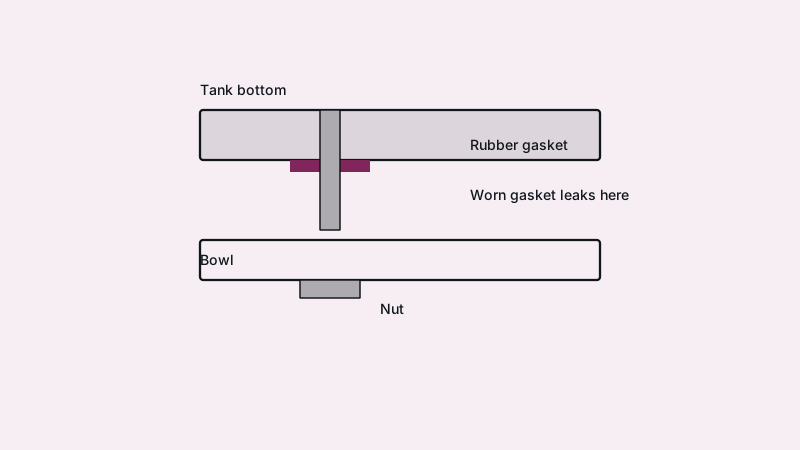
Empty the tank first. Pin each bolt head from inside with a screwdriver while a wrench loosens the nut underneath, then lift the tank clear. Fit a new gasket and bolts with fresh washers, seat the tank, and snug the nuts in small alternating steps. Stop at snug, since a cracked tank cannot be patched.
A fitting at the wall is wet. Now what?
Where the braided line meets the valve, tighten the nut finger-tight and then add a short pliers turn. Still beading? Replace the line, an inexpensive swap needing no solder. If the drip comes from the valve stem, the packing nut is loose or the valve itself is worn out.
Old shutoff valves tend to seize or snap when turned, and when the valve will not turn, the main shutoff is the only way left to stop the water. Swap it while you are there. The fill mechanism has its own page, toilet fill valve repair.
Could the wetness just be condensation?
In humid weather, yes. A tank full of cold water chills the porcelain, and moisture in the air condenses on the outside and drips to the floor. Wipe the tank dry and watch. Condensation beads across the whole tank at once; a leak returns to a single point.
It does no harm, and a bath mat or a tank liner takes the edge off. Running the bathroom fan after showers helps as well.
Which leaks are better left to a plumber?
Phone a plumber if the floor feels spongy, if the tank or bowl has a hairline crack, if the flange is broken or sunk below floor level, or if a fresh wax ring failed to stop the water. Cracked porcelain cannot be fixed and the toilet is replaced. Water that reached the subfloor needs an inspection, and with a bathroom upstairs, the ceiling below may show it, as covered in ceiling water damage.
Many Mission Viejo houses date to the 1970s through the 1990s, when the city grew from about 12,000 to about 73,000 people, so the toilet or its floor flange may be original. Replacement costs are on the toilet replacement page. Work at $1,000 or more needs a state contractor license, and an ordinary toilet repair sits far below that.
Does a wobbling toilet cause leaks?
Often. A bowl that rocks works its wax seal loose, so many base leaks begin as a wobble. Push the bowl side to side to test it, then snug the bolts. If it still shifts, suspect the floor or the flange. A loose seat is a different annoyance, and repairing a loose toilet seat covers it.
Common questions
Which repair stops a leaking toilet fastest?
Dry the porcelain, find where the first drop forms, and replace the matching part. Bolts get tightened or a wax ring replaced at the base; washers or a gasket under the tank; a new line at the wall; a flapper for silent leaks. Close the supply valve before any of them.
Will a homeowner manage this alone?
For most leaks, yes. A flapper, supply line or tank bolt set takes about an hour with basic tools. Resetting a wax ring is heavier, since the bowl has to be lifted. Cracked porcelain, a damaged flange or soft flooring near the base is where a homeowner should stop and ring a plumber.
What does a leak that shows up on flushing mean?
Flushing pushes water through the base seal and the tank joint under pressure. A puddle that appears on a flush points to the wax ring or the floor bolts. Drips from the tank seam on a flush point to the gasket or tank bolts. Note where the first drop forms during the flush.
How many years does a toilet last?
The porcelain often outlasts the house, while the parts wear out on their own schedule: flappers, fill valves, wax rings and washers. EPA says replacing an old toilet can cut toilet water use by 20 to 60 percent, and labeled WaterSense models stay at or below 1.28 gallons a flush.
For the wider picture, start with plumber mission viejo.
Sources
Updated