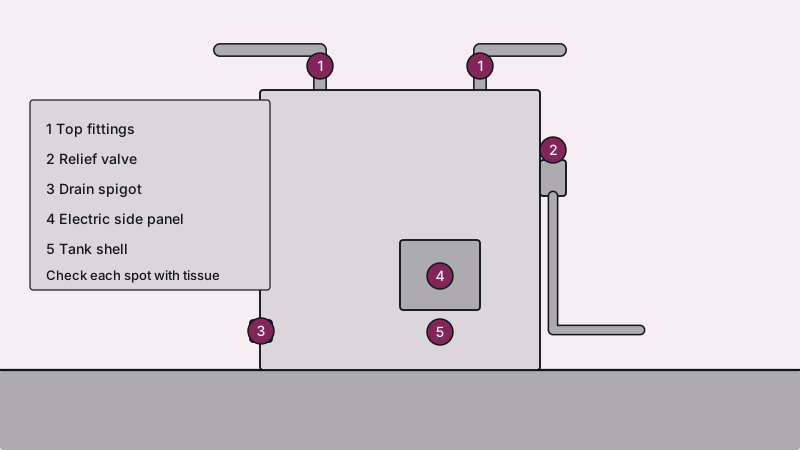
Puddle by the heater? Stop the water first, then find the source, because the source decides everything. A weeping drain valve or fitting is a wrench job. Water coming through the steel shell is not repairable, and the heater is done. Wider faults live on the heater repair hub. This guide sticks to leaks.
What should I turn off the moment water appears?
First the cold supply: close the valve atop the heater. Then the heat. An electric tank loses its breaker, and a gas tank gets its control set to off while the gas pipe stays untouched. If gas is in the air, step outside and tell SoCalGas (1-800-427-2200).
Order matters. A tank that keeps filling feeds the leak, and an electric element sitting dry in a draining tank can be ruined. Park a bucket under the drip. Opening a hot tap upstairs lets air in, so the tank can drain if you decide to empty it. If water is creeping toward drywall, towels go down first and a wet vacuum second.
How can I tell where the leak is coming from?
Dry the jacket with a rag, tuck a strip of tissue against every joint, and give it ten minutes. The tissue that darkens marks the source. Five places account for nearly every case: the fittings in the top plate, the relief valve with its discharge pipe, the spigot near the floor, the side panel of an electric heater, and the tank body.
A short field guide helps.
| Water appears at | Usual cause | Fix |
|---|---|---|
| The pipes on top | Fitting worn or loose | Tighten, or new connector |
| Pipe beside the heater from a valve | Relief valve venting | Leave it to a plumber |
| Spigot low on the side | Seal worn | Hand-tighten, or new spigot |
| Behind the side panel | Element gasket | Power off, swap the gasket |
| Underneath, steady | Shell rusted through | New heater |
Beads of moisture are not always a leak. A cold fill on a humid day makes the shell sweat, and a gas burner produces some water vapor that condenses on the flue early in a cycle. If the wet patch is gone an hour later and the paper stays dry, relax.
Is the relief valve leaking, and is that dangerous?
Treat a relief valve that drips as an alarm bell. The valve opens to stop a tank from over-pressurizing or overheating, and codes generally require its discharge pipe to run to a drain or outdoors, according to Wikipedia's water heating entry. Never cap that pipe. A valve that trickles may be worn, or it may be reacting to real pressure.
The common culprit is thermal expansion. Warm water expands. If the house plumbing is a closed loop, that extra volume has only one way out, the valve. An expansion tank soaks it up. Work on either part is spelled out on the relief valve replacement and expansion tank pages. High street pressure in a hillside tract can cause the same dribble, which a regulator fixes.
Which leaks can a homeowner stop without a plumber?
You can deal with a loose supply fitting, a weeping spigot and a flexible connector that has gone stiff and crusty. You cannot patch the shell, and sealants are a gamble on a vessel that holds pressure and heat. Gas connections, vent changes and a full swap are contractor work, and a swap usually needs a city permit.
For the spigot: close it by hand, then check for grit by opening it over a bucket. For a fitting: a small nudge with a wrench is enough, and more force can crack a threaded port. Fresh plumber's tape on threads helps. If metal is flaking or green crust is around a joint, the part has to go, so shut the water off and arrange a visit.
Repair or replace: which is smarter for a leaking tank?
Fix it when the tank is intact and the failing item is a part. Swap the heater if the shell is the leaking part, if it has run most of its normal lifespan, or if the bill is heading toward half of a new one. The data plate shows the model and a serial number that most makers use to encode the build date.
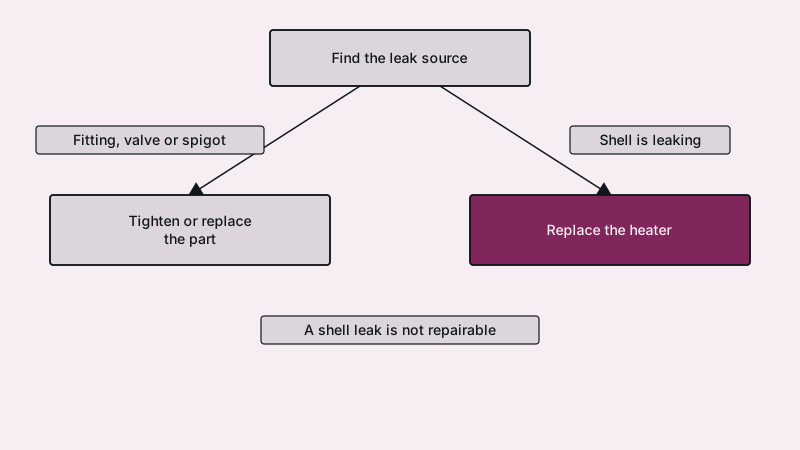
Mission Viejo water is hard to work with. Water in south Orange County is commonly hard, your water district's annual quality report lists the hardness number, and scale at that level coats elements and sits on the tank floor. Flushing a tank and changing the sacrificial rod can stretch its life, as the anode rod guide shows. If the tank itself is the leak, the replacement cost article walks through a new unit.
Does it matter if my heater is a Rheem, a Whirlpool or a Bosch?
For finding the leak, no. Any storage heater leaks at the same five spots. For ordering parts, yes: the plate lists model, serial and voltage, and a plumber needs all three. Tankless units, Bosch among them, tend to leak at inlet and outlet connections or when scale damages the heat exchanger, which is a different repair.
If the heater is under a manufacturer's warranty, find the receipt and registration before anyone drains it. For tankless faults see the gas tankless repair page. Ask whoever visits to check the wall straps too, since Wikipedia notes some codes require strapping in earthquake areas and brackets rust on a heater that has been wet for months.
What will fixing the leak cost, and is a permit involved?
A simple part swap is often a one-visit job, while a replacement takes longer and costs more because of the unit, the venting and the permit. Minor fixes appear at the cheap end of published repair guides. We do not name a number here, since it depends on what is found behind the leak.
Ask that parts, labor, permit and old-tank disposal appear as separate lines. Mission Viejo requires permits and inspections to be submitted and scheduled through its online Client Self Service portal, and Building Services answers questions at (949) 470-3054. More on that is under water heater permits. Water spreading right now? The emergency heater repair page is the faster read.
Common questions
Can a slow water heater leak damage a floor?
Yes. A slow leak can soak a subfloor, swell the bottom of a closet wall and grow mold before a puddle ever forms. The paper towel test catches it early. For a garage heater, run a hand along the baseboard of the shared wall as well. Photograph everything before cleanup and report it to your insurer promptly.
Should I drain the tank after it leaks?
Only when the heater is going out, or a part below the waterline is being changed. Screw a garden hose onto the spigot, aim it at the driveway or a floor drain, and open an upstairs hot tap. Keep the energy off and the cold supply closed. The first water out can scald, so give it time to cool.
The wetness is near a gas connection. Now what?
Go outside first, then ring SoCalGas. Tape and wrenches are not the answer here. Once the line is declared safe, a plumber checks the flex connector and shutoff, and replaces what is worn. Our gas line page covers who is allowed to do gas piping and why a permit matters.
Is the dripping always from the heater?
No. Water on the floor can come from a supply pipe above, a washing machine line nearby or a ceiling leak running down a wall. Look at the pipes overhead and the cold line entering the tank before blaming the heater. A dry heater with a wet floor points the search somewhere else.
The rest of our guides start from the plumber guide for Mission Viejo.
Sources
Updated