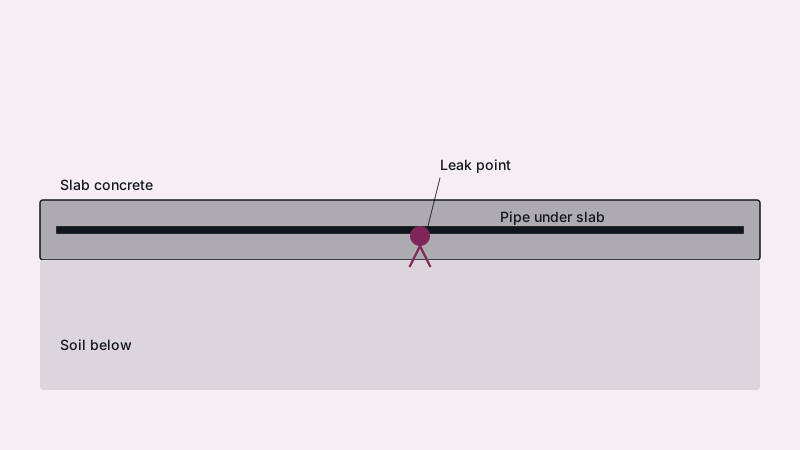
A good slab leak company finds the leak before it breaks anything, explains the repair choices in writing, and tells you who pulls a permit. Slab leaks run through the concrete floor, so the first questions are how they locate it and whether the plan is to patch the one spot, bypass the line or redo the plumbing. Our leaks plumber page covers the bigger picture. This page helps you compare the people you call.
What happens when a slab leak company takes the job?
First comes the search for the leaking pipe, then a decision on how to reach it or bypass it, then the repair and the floor restoration. Where companies differ is in the tools used to find the leak and in which repair gets pushed first. Here is the usual order of events.
Typical stages:
- Confirm the leak. The company checks the meter, isolates lines and listens, so you are not paying to open a floor for the wrong problem.
- Pinpoint it. This Old House recommends video inspection for hard-to-find leaks, to limit how much slab is opened.
- Choose the method. The options are a spot repair of the broken section, rerouting the line around the slab, or replacing the line.
- Repair and restore. If concrete is cut, it must be patched, and flooring may need to be put back.
- Test and sign off. A pressure test confirms the line holds, and any permit is closed out.
How do I know I have a slab leak and not another leak?
Watch for a climbing bill, the hiss of water when nothing is on, warm floor patches, damp carpet, a musty smell and weaker pressure. This Old House sorts the signs into early, noticeable and advanced. Before calling a company, check the meter. A dial that turns while the house is idle means water is escaping.
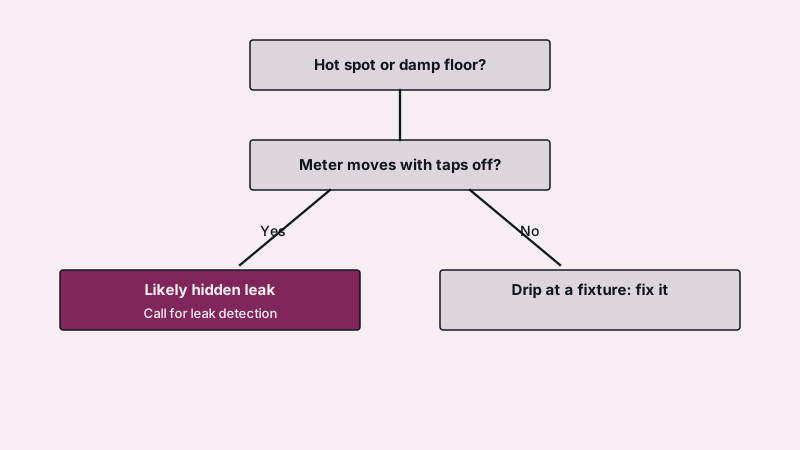
EPA's version is simple: no water use for two hours between two meter readings. Rule out toilets and sprinklers next. If the meter still creeps, the leak is in a pipe. Heat coming up through the floor, especially over a hot line, points at the slab. The pipe burst signs page lists more clues.
What should I ask a slab leak repair company before hiring?
Six questions work: the contractor license number, the way the leak will be found, the proposed repair and the reasoning, who applies for permits, what the concrete and flooring lines cover, and the all-in total. A company that cannot answer before touching your floor is the wrong one.
Insist on paper. CSLB's contract page calls for a written agreement above the $500 mark, with a described scope, payment schedule, finish date and permit owner. Expect a capped deposit and payments that trail the finished work. This is also the moment to look into insurance. See slab leak insurance coverage before you start, because claims often depend on how fast you report the damage.
Which repair methods should the company explain?
Three methods come up. A spot repair mends only the broken section, tunneling beneath or breaking through the slab. A reroute leaves the damaged line dead and runs a new one through the walls or attic. A repipe replaces most of the supply lines, which suits a house where leaks keep coming back.
This Old House describes rerouting as installing new pipes and abandoning the damaged lines, which avoids cutting much of the slab but can mean more labor inside the home. Which fits depends on where the leak is and the age of the rest of the pipe. Choosing between them is the subject of repair or repipe for a slab leak, and the bigger job is described under repiping a house.
One caution: a full repipe quoted on the first visit, with no testing behind it, deserves a question. A repipe is right when the pipe is failing everywhere. Copper from the 1960s to 1990s is common in planned-community homes in this area, and pinhole leaks can appear in several places, but only a test and an inspection show whether yours has.
How much do slab leak repairs cost?
Overall, guides report $630 to $4,400 for a slab leak repair, with an average near $2,300. Broken down by This Old House: finding the leak, $150 to $600; a split pipe, $200 to $2,000; a reroute, up to $15,000 at the top end; slab replacement, $3,600 to $8,000. Read them as a yardstick, since only your written quote is a price.
| Part of the job | Published range |
|---|---|
| Leak detection | $150 to $600 |
| Waterline repair | $300 to $1,400 |
| Split pipe repair | $200 to $2,000 |
| Reroute | $1,500 to $15,000 |
| Overall repair | $630 to $4,400 |
Floor finishes, access and house size move the figure. Check that flooring and concrete patching are inside the quote, since many companies bill them separately. The slab leak repair cost article itemizes the pieces.
Is there a permit, and who handles it?
Rerouting and repiping commonly call for one, and the contractor should be the one applying. In Mission Viejo, permits and inspections run through the online Client Self Service portal, with Building Services at (949) 470-3054 for questions. If a company waves the permit away without looking at the scope, ask again.
Check that the permit fee and the inspection sit inside the price, and file the sign-off. Buyers and insurers sometimes ask to see it years later.
Common questions
Can a slab leak wait?
Not for long. Water escapes by the hour, and it can weaken the floor, soak insulation and feed mold. If you suspect one, close the main valve whenever the house stands empty and book detection soon. A pipe actually bursting is more urgent still, as the burst pipe plumber page explains.
Does homeowners insurance pay for slab leak repair?
Cover often reaches the water damage from an abrupt leak, while the pipe fix and gradual seepage are commonly left out. Your policy wording decides. Report quickly, photograph the damage and keep the plumber's report. Our slab leak insurance page explains what to ask.
How disruptive is a slab leak repair?
That depends on the method: a spot repair can be a day or two, a reroute or repipe stretches longer, and flooring adds more. Have the schedule and any water shutoff dates written into the contract, and ask how the work is staged so you can keep a bathroom running.
What if the company wants to jackhammer the floor first?
Ask why. Location work belongs first, because a precise spot limits the concrete opened. If the plan is to break the slab, get the reason on paper, ask whether a reroute costs less, and collect a second quote before you agree to anything.
For the wider picture, start with plumber mission viejo.
Sources
Updated