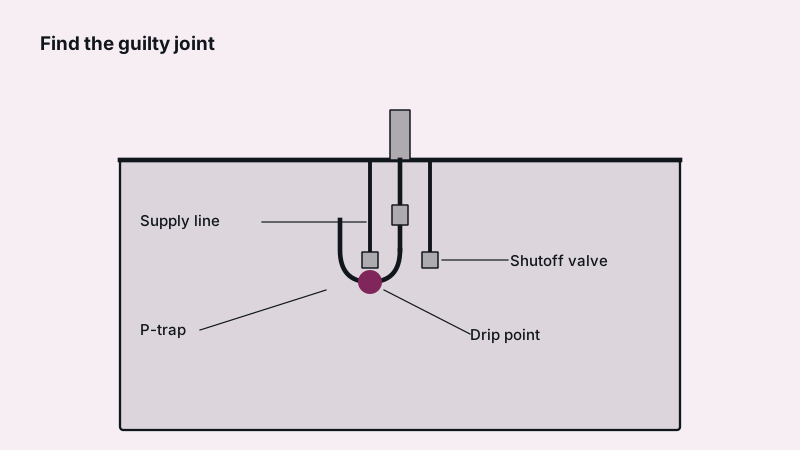
Dry the cabinet, wrap a paper towel around each joint in turn, and run water. The joint that darkens the towel is your leak, and most of them are fixed with a wrench and a washer, not a new pipe. If the leak sits at a garbage disposal, a fixture drain or a corroded supply, the repair changes, and so does the point at which you phone someone; a plumber can be booked with the quote request. Under-sink work around a disposal is also covered at garbage disposal repair.
How can I tell which connection is the guilty one?
Clear the cabinet, dry every surface and slide a tray under the pipes. Two tests separate the causes: run the tap to expose supply leaks, then fill the basin and release it to expose drain leaks. A dry tissue pressed on each joint turns dark at the guilty one.
Check from the top down. Water running down from the faucet base looks like a pipe leak, so look at the underside of the sink first. Slow drips along a pipe may be condensation on a cold supply line in humid weather, which is harmless and has no joint to fix. A mirror and a flashlight help on hidden connections at the back of the cabinet.
What is the right repair for each kind of connection?
Each connection has its own cure. Slack slip nuts on the drain just need tightening by hand. A cracked trap is replaced. Braided supply lines that weep at the nut are swapped whole. When the shutoff drips from its stem, snug the packing nut or fit a new valve.
| Where it leaks | Usual cause | Typical fix |
|---|---|---|
| Plastic slip nut on the drain | Loose nut or worn washer | Tighten by hand, or fit a new washer |
| Bottom of the P-trap | Cracked or corroded trap | Replace the trap |
| Where the drain meets the sink | Dried putty or loose flange | Remove and reseat with fresh plumber's putty |
| Supply line at either end | Worn washer or kinked line | New braided supply line |
| Shutoff valve stem | Worn packing | Snug the packing nut or replace valve |
| Faucet shank behind the sink | Failed gasket or loose nut | Tighten the mounting nut or reseat |
| Disposal seam | Failed gasket or flange | Disposal repair or replacement |
What is the fix for a dripping P-trap?
Put a bucket beneath, then back the slip nuts off by hand. Inspect the tapered plastic washer and refit it bevel-side toward the joint. Line the pipe up, run the nut on snug with your fingers, and finish with a quarter turn of pliers at most. Plastic splits when overtightened.
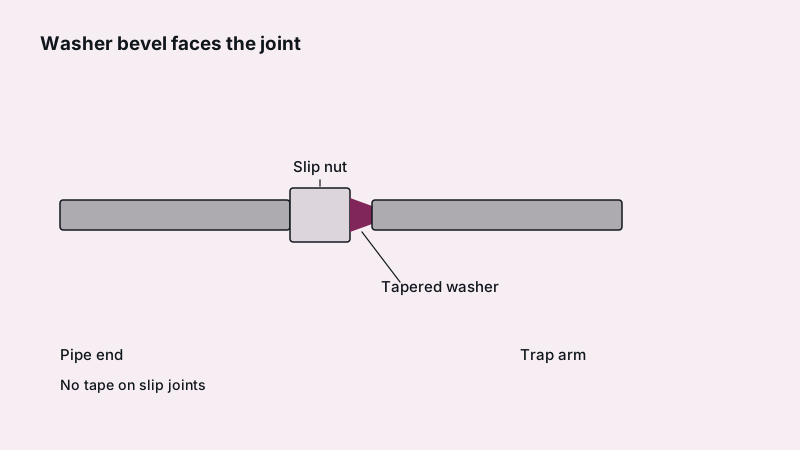
If the trap itself is cracked, replace the whole piece with a matching size, usually 1-1/4 or 1-1/2 inch. A drain kit from a hardware store is the usual part, and the swap takes about ten minutes. Run a full basin through it afterward and watch for drips. Still weeping after a fresh washer? The pipe is probably misaligned and needs repositioning. Tub-side leaks are a separate subject, handled in fixing a leaky tub faucet.
What if the water comes from a supply line or its valve?
Turn the stop valve off under the sink, or the main if that valve is frozen in place. Braided supply lines that weep at the ends or have kinked never heal, so buy a new one. Tighten its nut with your fingers, then a little more with a wrench, and test with a dry tissue.
A stem that seeps behind the handle usually calms down after the packing nut gets a quarter turn. If that fails, the valve needs replacement, and on older homes that can mean a copper cut-and-solder job. Soldering under a cabinet involves an open flame and is best left to a plumber. Pinhole leaks in copper pipe itself are a different problem, covered in repairing a pinhole in copper pipe.
Is the drip really coming from the faucet above?
It could. Water slips down the spout base when an O-ring or cartridge fails, then drips from the underside and mimics a pipe leak. A loose mounting nut lets the fixture shift too. Snug the nut from beneath and retest with the tap running.
Water visibly leaking from the handle or spout means the repair is at the faucet, and the cartridge and seal steps are in fixing a leaky sink faucet. When the whole faucet is old, replacing it may cost little more than repair; faucet replacement cost shows the numbers.
Is a slow drip under the sink worth fixing today?
Yes. A slow leak rots the cabinet floor, feeds mold and lifts finishes while nobody is looking. It adds to the leak total EPA attributes to a typical home, more than 9,300 gallons yearly. Dry the cabinet fully and look again tomorrow to see whether the drip returned.
Look for swelling, stains and soft particleboard at the cabinet base, which suggest the leak has run for a while. If the wood is soft, replace that panel. A moisture meter or a sniff test for mustiness tells you more than the eye. Any ongoing dampness after a repair means the leak is not fixed, or a second leak exists.
At what point does this stop being a weekend job?
Pipe eaten through by corrosion, a shutoff stuck open, a drain cracked inside the wall, water seeping from the wall or floor, or a leak that outlasts new washers: any one counts. A cabinet that has stayed wet for days belongs on the list too.
A plumber can replace corroded supply stubs, a failed shutoff or a cracked drain stub-out in a single visit. We found no sourced price for that visit, so the written quote sets it. Published guides put plumber labor at $45 to $200 an hour. Galvanized steel pipe may mean the whole run is due; galvanized pipe replacement explains how that is judged.
Common questions
Can I use plumber's tape on a drain slip joint?
No. Slip joints seal with a tapered washer, not thread tape, and tape can prevent the washer from seating. Use tape on threaded metal connections such as a supply fitting. Plastic compression nuts use the washer too. If a slip joint leaks, check the washer's direction and fit before reaching for sealant.
Is silicone sealant a good fix for a leaking pipe?
Not as a repair. Silicone smeared on a leaking joint hides it for a while and then fails, often after the cabinet is wet again. Fix the cause by tightening, resealing or replacing the part. Silicone is for sealing a sink to a counter, not a pressurized or draining pipe.
Roughly how much is a plumber visit for an under-sink leak?
We found no sourced figure for an under-sink leak call, so none is printed here. The bill rises when a disposal, valve or pipe run needs replacing. Get the price on paper first. The parts are cheap; access and time are what make the bill.
What if the shutoff valve under the sink is stuck?
Walk to the house's main valve, turn it off, then open the lowest tap to drain what is left in the pipes. The seized stop valve gets replaced during the repair. Learn where the main is before trouble starts, so nobody hunts for it while water runs.
For the wider picture, start with the plumber guide for Mission Viejo.
Sources
Updated