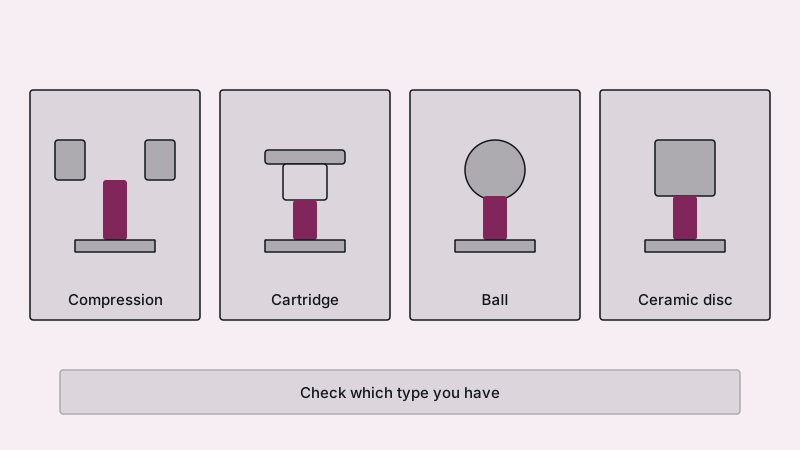
Start with the two little valves in the cabinet below, and shut both. Next, identify your faucet design. Water falling from the spout points to a tired washer, cartridge, ball or disc; a dribble at the handle points to an O-ring or packing nut. Pair the right part with the right design and the job is done. Anything bigger, including drains and disposals, goes to a kitchen sink plumber.
Which type of faucet do I have?
Four designs cover most homes. Compression faucets have separate hot and cold handles that you screw down; cartridge faucets have a single lever or two handles that turn smoothly; ball faucets have one lever over a rounded cap; ceramic disc faucets have a single lever with a wide cylinder body. The brand name on the spout or an online model search settles it.
Take off the handle to see. A rubber washer on the end of a threaded stem marks a compression faucet. A brass or plastic cylinder means cartridge. A slotted ball with springs and seats means ball type. Two ceramic discs inside a cylinder mean disc. Photograph each layer as you go, because the order matters at reassembly.
What do I need before starting?
Gather a flat and a Phillips screwdriver, an adjustable wrench, pliers, hex keys, a rag, a cup for screws and plumber's grease. Buy replacement parts only once the old ones are in your hand. Plug the sink drain with the rag, since small screws love to disappear.
Turn each cabinet valve clockwise until it stops, then run the faucet briefly to drain the pressure and prove the water is off. If a cabinet valve will not close or weeps as you turn it, shut the main instead and phone a plumber, because forcing it can snap the stem.
What cures water dripping out of the spout?
The part depends on the design. In a compression faucet, swap the rubber seat washer, and if the seat has pitted, resurface or replace the seat. On a cartridge faucet, pull the cartridge, bring it to the store, and fit an exact match. On a ball faucet, replace the seats and springs, or the whole ball. On a ceramic disc faucet, replace the cartridge or its seals.
Match parts at the store, not from memory. After reassembly, crack the handle open slowly after unscrewing the aerator, which lets loose debris wash through. Then watch the spout for a few minutes. The EPA's math: a drip each second can waste over 3,000 gallons annually.
What about seepage under the handle or spout?
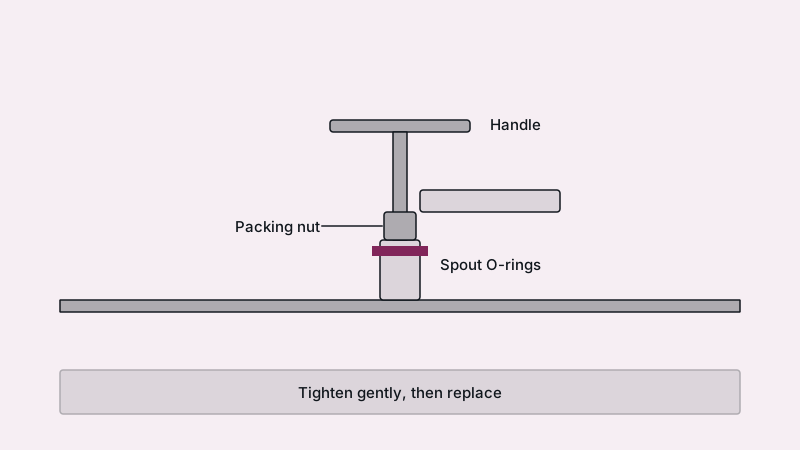
Moisture around the spout base usually means worn O-rings where the spout swivels. Remove the spout, slide off the old O-rings, coat the new ones lightly in plumber's grease and replace them. Water under the handle points to a loose packing nut, a worn stem seal or a cracked cartridge. Tighten the nut gently, and if it persists, replace the seal.
Corrosion and mineral scale can cause both. Crusty parts can sit in vinegar for about an hour before a brush goes over them, which either saves them or proves they are finished. Hard water means scale, and ask your water district for hardness figures to know how often it will recur.
What if the cabinet below is wet?
The cause is often a supply line, a stop valve or the drain trap rather than the faucet itself. Wipe everything dry, run the water, and touch a dry tissue to each joint in turn; the damp one is your leak. Supply fittings frequently need only a quarter turn of a wrench, and a failed braided line is inexpensive to replace.
A trap leaking at a slip nut may just need hand tightening or a new washer. Pipe-level fixes are covered in fixing a leaking pipe under the sink. A spongy or moldy cabinet floor suggests a long-running leak.
Is it time for a new faucet instead?
When the finish is pitted, parts are no longer made, the body is cracked, or you have fixed it twice already, a new faucet is better. A new unit also suits owners who want a different style or a pull-down spray. Budget notes live in replacement pricing and installation pricing.
Faucets in planned-community homes from the 1970s to the 1990s may be original and hard to match. Replacement also gives a chance to renew the supply lines and shutoff valves.
Do I need a plumber, and what does the law say?
A simple faucet repair is a homeowner job. Call a plumber if shutoffs fail, supply pipes corrode, the wall is wet, or you are unsure. The state's contractor-license threshold is $1,000; faucet repairs usually fall well under, but rebuilding pipework behind one can top it.
Keep the old parts, take photos, and ask for a written price. A price request gets a visit arranged. Worried about the meter? See whether a leaky faucet drives up the bill.
Common questions
Why does it still drip with a brand-new washer?
A pitted or worn seat gives the new washer nothing to seal on. Resurface the seat with a seat wrench and dresser tool, or replace it. A wrong-size washer or a cracked cartridge are other possibilities. If it still drips, replacing the whole faucet is often quicker than chasing parts.
What about the tub or shower faucet?
The logic carries over: identify the type, change the cartridge or washer, check the O-rings. The valve sits behind the wall, though, so isolating the water supply takes more effort, and some homes need the main shut off for it. Specifics are at tub faucet leaks and shower faucet leaks.
Can I use plumber's tape on a faucet leak?
Plumber's tape (PTFE) seals threaded pipe connections, such as the supply line to the shutoff valve. It does not fix drips from a spout or handle, which come from worn internal parts. Using tape on compression fittings or rubber seals does not help and can interfere.
How long is the sink out of service?
Plan for about an hour of actual work on an ordinary faucet, with a separate errand for parts. Corroded, stubborn pieces add time, and a full replacement takes longer, so expect the sink to be unusable for a few hours.
For the wider picture, start with Mission Viejo plumber.
Sources
Updated