Mission Viejo rarely sees hard freezes, so most manufactured homes here do not need a full winter shutdown every year. The cases that do: a unit left empty for weeks, a second home in the mountains, or a night forecast near freezing with exposed pipes under the floor. Then you either keep heat on and insulate, or drain the system and fill the traps with antifreeze. Both routes are below, along with the layout, the vents and the usual faults. The Capistrano Plumbing home page has the wider menu of what we arrange around Mission Viejo and its neighbors.
When does a Mission Viejo manufactured home actually need winterizing?
Winterize when you will be away through a cold forecast, when the home is empty, or when pipes sit exposed under the belly with damaged insulation. In Mission Viejo, freezing nights are uncommon, so many owners only need pipe insulation and a plan for the rare cold snap. A vacant unit or a mountain getaway needs a full drain-down.
Quick test: if lows are forecast near 32 degrees and the home will be unheated, treat the plumbing as at risk. Ice takes up more room than water, so pipes split at fittings or along a run. The damage shows itself only at thaw, when water starts pouring.
How is the plumbing in a manufactured home arranged?
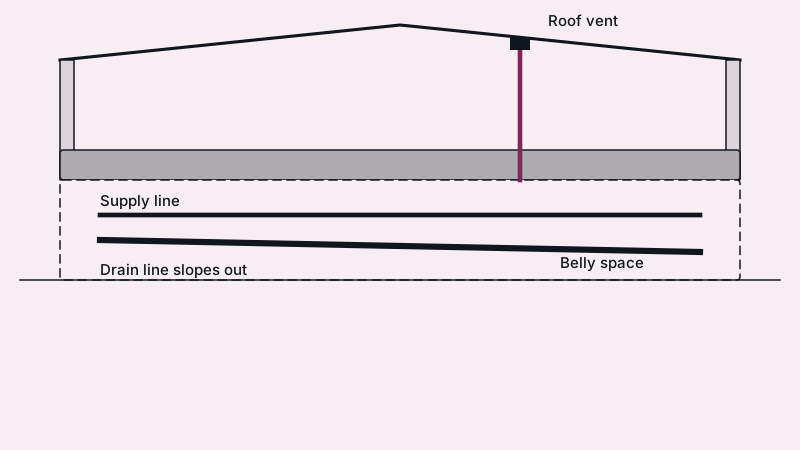
Three systems share the floor and roof. Supply lines run along the underside in the belly, usually PEX or CPVC in newer units and sometimes polybutylene in older ones. Drain lines are ABS pipe that slope toward a single exit. Vents rise from the fixtures to the roof. The water heater sits in a closet with its own gas or power feed.
The federal code that governs construction applies to manufactured homes built after June 1976. It sets how pipe is sized, supported and vented, which is why layouts look alike from one brand to the next. Two details matter for winter:
- Supply drops sit low. Branches to the kitchen and bath run just above the belly wrap, where cold air reaches them.
- The crossover. On double-wides, a flexible connector joins supply lines where the two halves meet, and it is a common freeze point.
Where older polybutylene is present, read polybutylene pipe replacement, because brittle pipe fails first under freeze stress.
What is the drain-down procedure, in order?
Heater off first, then the water, then drain the lines, then fill each trap with non-toxic RV antifreeze. Skipping the order risks a burned-out heater element or a tank that never empties. Only propylene glycol made for RV drinking systems belongs in these drains. Car antifreeze is poisonous.
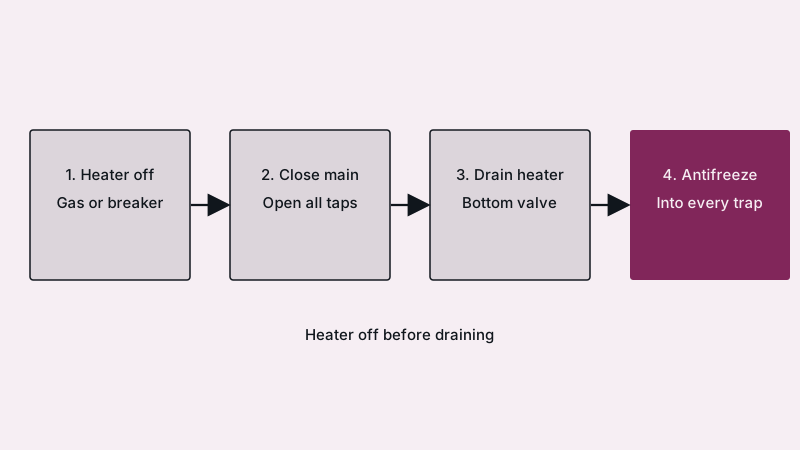
- Turn off the heater. For gas, set the gas valve to off and the pilot to off. For electric, flip the breaker, so the element never fires dry.
- Close the main at the inlet and open every faucet, hot and cold.
- Drain the heater at its bottom valve with the relief valve lifted, to let air in.
- Open the lowest drain points or the low-point valves if the home has them.
- Flush toilets, then sponge out the tank and bowl.
- Pour about a cup of RV antifreeze down every sink, tub and shower, and a pint into each toilet bowl.
- Cap or bypass the heater if you will pump antifreeze through the lines, so none enters the tank.
Leave the gas appliances off, and do not run the dishwasher or washer with antifreeze in them unless their manual allows it. Smell gas while you work? Walk out. Once you are in the yard, the number for SoCalGas emergencies is 1-800-427-2200. If you feel threatened, 911 comes first.
What insulation protects the pipes under the floor?
Sleeve exposed supply lines with foam, close gaps in the skirting, and patch torn belly wrap. For long stretches, add UL-listed heat cable, installed to its instructions. Insulation slows freezing, it does not stop it, so pair it with heat in the home for any cold snap.
Checklist for the crawl space:
- Check the skirting for open panels and foundation vents that are not closed for the cold.
- Look for torn or sagging belly wrap and re-seal it with tape made for it.
- Slip foam tubes over exposed lines and tape the seams.
- Keep cabinet doors open below sinks on cold nights to let house heat in.
- Let a faucet drip when the forecast is hard.
Do not stuff loose insulation around a gas line or the heater's flue, which need air.
How do I check the plumbing vent and its cap?
Vents let drains breathe. A blocked or capped vent gurgles, drains slowly and smells like a sewer. Each vent stack pokes out of the roof, often wearing a rubber boot and a cap. Look at it from the ground with binoculars, and go up only when the roof is dry and can bear your weight.
Manufactured roofs can be thin, so many owners hire a pro for any roof work. Signs to watch for:
- A cracked boot or flashing, which leaks into the ceiling.
- A nest, leaves or a toy ball stuck in the stack.
- Gurgling at a sink when a nearby tub drains.
- Sewer odor inside, usually from a dry trap or a failed under-sink air admittance valve, which some homes use in place of a roof vent.
A cap that is too fine, or one painted shut, can restrict airflow. Replace it with the correct type. Many older units have had patch work done over the years, and the vent runs under the roof are not always where a diagram says.
What goes wrong with mobile home plumbing most often?
Leaks at fittings, low pressure from a clogged aerator or regulator, a water heater that fails, and drains that slope wrongly. Under the home, damaged belly wrap lets rodents and cold in. Older polybutylene fails at its fittings, and flexible connectors age.
Pick the right next step:
- Water under the floor or a spongy spot: shut the main and call for a plumber.
- Heater trouble: the price guide for a mobile home heater swap.
- New piping or reroutes: installing plumbing under a mobile home.
- A full check-up: mobile home plumbing inspection.
What are a maintenance plumber's duties on a home like this?
The job is keeping an existing system working: inspecting supply and drain lines, fixing small leaks, testing backflow devices, servicing water heaters and clearing blockages before they become emergencies. For a manufactured home, that means an annual walk under the floor and a look at the vents and heater.
Typical duties include:
- Checking shutoffs, regulator and pressure.
- Tightening or replacing fittings and flexible connectors.
- Looking over the heater, relief valve and flue.
- Spotting rot, rust or damp around the belly.
- Advising on repairs that need a permit.
Which jobs are mine, and which need a contractor?
You can drain and insulate your own home. Plumbing work whose parts and labor reach $1,000 has to go to a California contractor; permits come from the city building department. For a plumber visit, the price request form is the place to describe your home.
Common questions
Is RV antifreeze safe in a house drain?
Non-toxic propylene glycol RV antifreeze is made for drinking-water systems and is the one to use. Never use automotive ethylene glycol. Flush it all out with clean water in spring, run each tap until it comes out clear, and replace aerators if they clog.
Can I leave the heat on instead of draining?
Yes, if power and gas stay on, the thermostat is set low and someone will notice an outage. It is the simpler option for short absences. Draining is safer when the home may lose power, or when you will be away for weeks.
Do I shut off the gas when I winterize?
Turn off the water heater's gas control and, if the home will sit empty a long while, close the main gas valve at the meter. An earthquake shutoff valve may also close the supply on its own. Relighting should follow the maker's directions.
Where is the main shutoff in a mobile home?
Often at the water inlet on the exterior near the skirting or on the lot's riser, with a second valve under the home. Locate it now, and make sure it turns. A stuck valve is worth replacing now rather than in an emergency.
Can a vent be fixed without climbing the roof?
Some can. A gurgling fixture with an air admittance valve under the sink is fixable from inside. A roof stack, cap or boot needs roof access. Thin manufactured roofs are easy to damage, so most owners leave that to a professional.
Sources
Updated